
Beyond the SaaS Era: Why AI Demands a Structural Replatforming
The introduction of Software as a Service (SaaS) fundamentally altered the vendor delivery model, shifting the burden of infrastructure management from enterprise IT departments to cloud providers. While this transition improved agility and reduced some technical friction, it failed to solve the deeper, structural issues of the modern firm. For most organizations, SaaS served as a digitization of existing manual workflows rather than a transformation of the underlying business mechanics. The organizational tax—the hidden cost of reconciling disconnected data, bridging departmental silos via spreadsheets, and relying on tribal knowledge to make decisions—remains the primary barrier to efficiency.
Artificial Intelligence marks a distinct break from this pattern. Unlike earlier software waves that merely streamlined IT, AI holds the potential to reshape core enterprise operations: capital allocation, risk management, and the fundamental execution of work. To capture this value, organizations must move beyond simply bolting LLMs onto legacy interfaces. The future belongs to enterprises that build a robust technical architecture capable of harmonizing deterministic constraints with probabilistic intelligence.
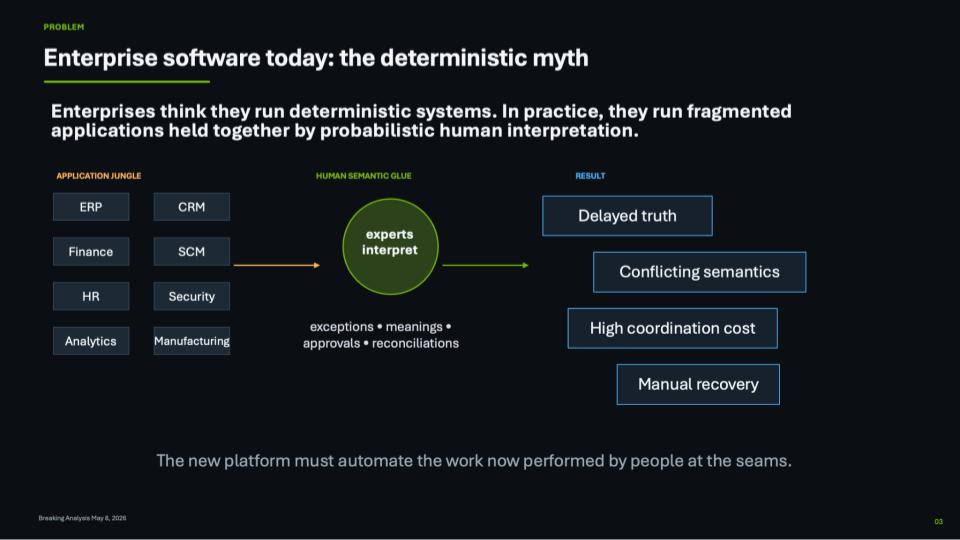
The Deterministic Myth and the Human Glue Problem
Enterprise leaders often operate under the misconception that their current software stacks are deterministic. While individual applications like ERP or CRM systems follow rule-based logic internally, the enterprise as a whole does not. When data must move across disconnected islands of software, the process degrades into a manual exercise. Humans perform the necessary semantic glue work—reconciling disparate meanings, mediating approvals, and interpreting exceptions.
Consequently, enterprise outcomes in this manual environment are functionally probabilistic; the same input across different teams often yields different outputs due to varying human interpretations. This represents a craft-work economy existing within a high-tech shell. As firms scale, this dependency on human coordination leads to compounding costs, as growth necessitates more layers of management, more meetings, and higher overhead. The transition to AI-mediated operations is, at its core, an economic shift: replacing expensive, high-variance human coordination with software-defined, repeatable intelligence.
The Agentic Stack: The Rise of the System of Intelligence
To move beyond point-solution automation, enterprises must adopt a layered stack specifically designed for agency. This architecture requires several distinct tiers:
- System of Truth (Historical/Real-time): The foundational layer of raw data and operational records.
- System of Intelligence (SoI): The critical middleware that defines business semantics, rules, and logic. This layer harmonizes cross-silo data, enabling agents to reason about the business as a coherent entity rather than a series of fragmented tasks.
- System of Agency: The execution layer where agents perceive, decide, and act against specific business outcomes, grounded by the constraints defined in the SoI.
- System of Engagement: The human-loop interface. Crucially, this is not merely a UI; it is an active learning cycle that captures human reasoning traces, corrections, and approvals to continuously refine the system’s performance.
The System of Intelligence is the most significant strategic real estate in this new stack. Without a shared semantic layer, agents remain trapped in local silos, unable to provide the forward-looking guidance—such as identifying why a variance occurred or forecasting the next optimal step—that distinguishes a truly automated enterprise from one simply accelerating its current inefficiencies.
Manufacturing Intelligence: The Full-Stack Digital Twin
The ultimate goal for the AI-driven enterprise is the creation of a Full-Stack Digital Twin. This is an expertise refinery where deterministic scaffolding—the rules, mappings, and regulatory requirements—is married to cognitive capabilities that capture how experts navigate complexity.
This maturation process acts as a ladder. Enterprises often attempt to skip to the cognitive layers, but AI will only deliver durable value once anchored to a verifiable deterministic foundation. Organizations must treat rules as code just as they once treated data as an asset. By externalizing business logic from legacy applications and embedding it into a centralized system of intelligence, companies can move away from resource-based governance (restricting access to rows and columns) toward intent-based governance (constraining what agents are permitted to do).
Economic Implications and the New Operating Model
The economic transformation of the enterprise is mirrored in the shifting composition of profit and loss statements. As leaders like those at Dell have suggested, the cost of tokens—the computational unit of reasoning—will become a major line item, eventually eclipsing legacy infrastructure expenditures.
This is not just a technological transition; it is an evolution in business model economics. By automating the human coordination previously required to bridge fragmented systems, companies can achieve service as software (SaSo) characteristics. This entails scaling revenue while keeping administrative labor costs relatively flat. Firms that succeed in this environment will behave less like traditional hierarchical organizations and more like platforms, where the compounding value of institutional learning and repeatable, AI-mediated outcomes creates a structural advantage that is increasingly difficult for competitors to replicate.
In this new paradigm, the org chart is no longer the primary mechanism for coordination. Instead, the shared model of business state and performance metrics becomes the North Star for all activity, moving the needle from individual productivity to organizational leverage.