
The Evolution: From Backup Utility to Autonomous Trust Layer
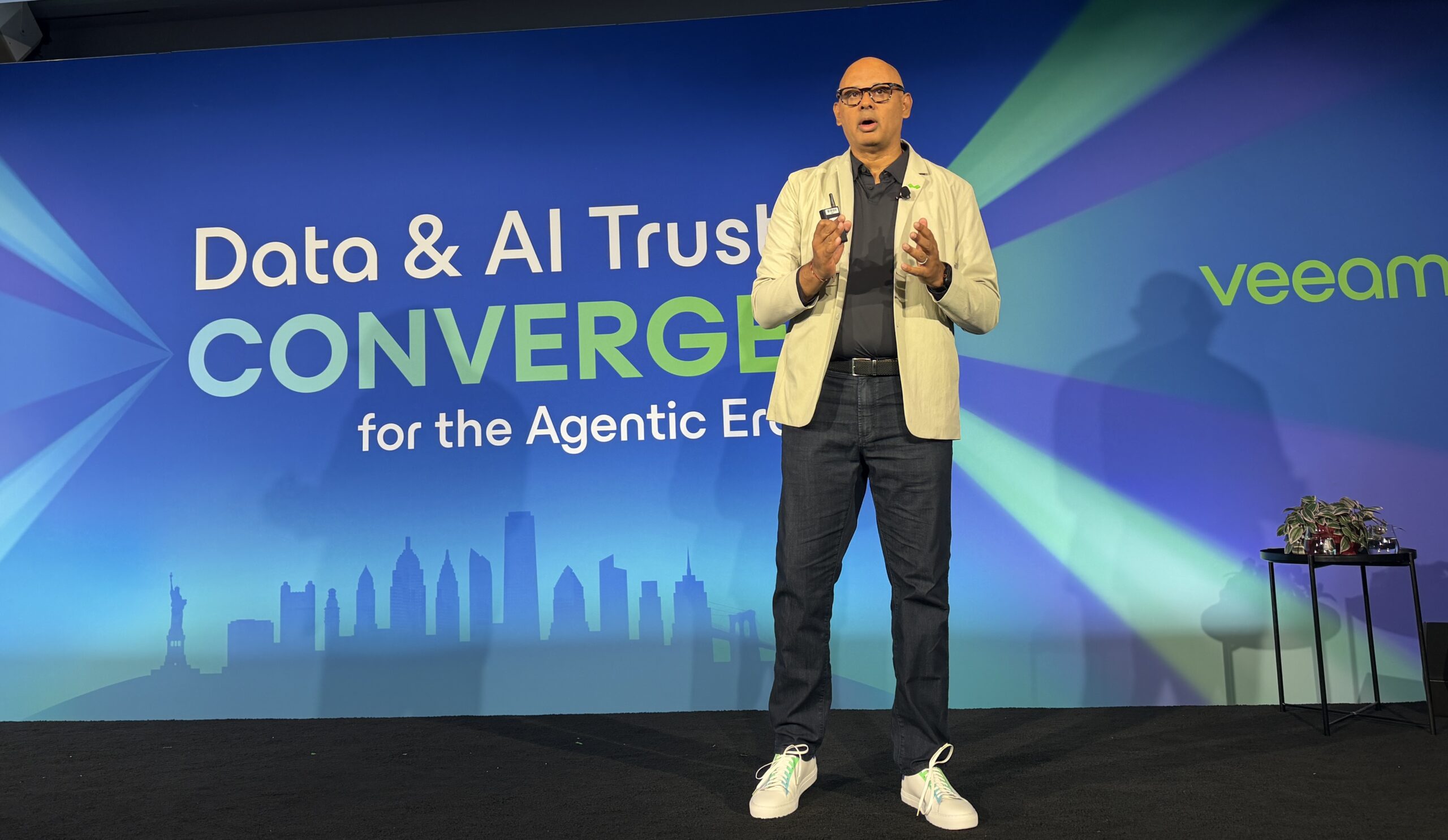
Veeam Software is undergoing a strategic metamorphosis. At this year’s VeeamON event in New York City, the company signaled a departure from its traditional identity as a backup provider, pivoting toward becoming a comprehensive data and AI trust platform tailored for the “agentic era.” By integrating advanced architectural layers and a rigorous new product roadmap, CEO Anand Eswaran and President of Products and Technology Rehan Jalil are steering the company toward a future where enterprise stability relies less on recovery speeds and more on the governance of autonomous AI actions.
Historically, Veeam built its $2 billion revenue model and reputation on the efficiency of its “instant recovery” capabilities. However, leadership now argues that while the need for recovery remains constant, the threat landscape has fundamentally shifted. Eswaran defined this evolution through three distinct stages: the era of traditional recovery, the era of ransomware-driven cyber resilience, and the current era of “assume autonomy,” where non-human agents act at a speed and scale that outpaces conventional security protocols.
The Agentic Risk: When Automation Becomes a Liability
Veeam’s internal research reveals a startling reality: in large enterprises, autonomous AI agents now outnumber human employees by a ratio of 82 to 1. Perhaps more alarming is that 97% of these agents possess excessive privileges. In this decentralized environment, legacy security models—which were designed around human oversight—are failing.
The industry is entering a territory where a misplaced command or a misconfigured agent can trigger a catastrophic failure in seconds. Whether it is an agent purging a database or a rogue process misconfiguring cloud infrastructure, the resulting downtime can lead to significant financial loss before IT teams even register an alert. Veeam asserts that the market currently offers infrastructure to deploy AI, but lacks the necessary infrastructure to trust it.
Engineering the Trust Infrastructure
To address this gap, Veeam has introduced the Veeam DataAI Command Platform. Born from the acquisition of Securiti, this platform merges data security posture management (DSPM) with Veeam’s deep history in data recovery. At its core lies the DataAI Command Graph, a unified intelligence layer equipped with over 300 connectors that map the relationships between users, AI agents, sensitive data, and permissions.
By treating data, identity, and resilience as a singular, interconnected system, Veeam seeks to solve the “fragmentation tax” that currently plagues IT departments. The platform facilitates several key functions:
DataAI Security & Governance: Centralizing control to prevent overprivileged agents from accessing sensitive repositories.
Compliance Automation: Mapping data flows against frameworks like the EU AI Act, DORA, and GDPR to provide real-time, defensible audit trails.
* Precision Resilience: Moving beyond full-system restoration to surgical, granular recovery that reverses only the specific actions compromised by an AI agent.
Competitive Implications and Market Positioning
Veeam’s pivot puts it on a collision course with a broader range of competitors, including identity-centric security providers, privacy automation tools, and specialized AI governance boutiques. However, Veeam’s advantage lies in its unique dual-plane visibility: having control over both the live production environment and the underlying backup repositories.
For the average enterprise, this represents a significant shift in procurement strategy. Managing security, privacy, and recovery as siloed functional disciplines is becoming increasingly untenable. Veeam is betting that CTOs will favor consolidation, opting for a platform that embeds trust directly into the lifecycle of data rather than relying on disparate tools that lack contextual awareness of an agent’s behavior.
Strategic Takeaways for the Enterprise
The move toward an “assume autonomy” architecture requires a proactive inventory of how AI agents interact with critical business data. Enterprises should treat the DataAI Command Platform’s maturity model as a roadmap rather than a sales pitch.
The message from New York is clear: the most agile organizations in the coming decade will be those that can prove, through sophisticated data mapping and automated governance, that their AI agents are operating within safe, auditable boundaries. As the agentic era accelerates, the companies that prioritize unified trust over fragmented defenses will be the ones that safely unlock the ROI of their AI investments.