
From Documentation Hub to Agentic Operating System
Notion is pivoting from its identity as a collaborative note-taking application to an enterprise-grade agent orchestration layer. By launching its new Developer Platform, the company is signaling its intent to dominate the agentic era of software—a shift where AI doesn’t just synthesize information but actively executes multistep workflows across the enterprise stack.
This evolution addresses the primary friction point of current AI integration: the fragmentation of data. Previously, Notion’s Custom Agents were confined to the internal workspace, unable to interface with live data external to the app. Users were forced to patch together disparate third-party automation tools, creating technical debt and data silos that necessitated constant, manual maintenance.
The Mechanics of Notion Workers
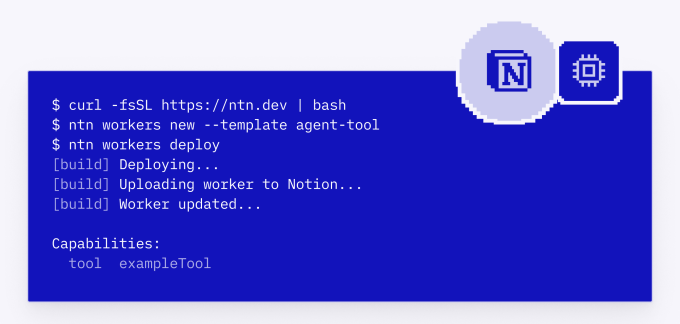
At the heart of this upgrade are Workers—a serverless, cloud-based environment allowing for the deployment of custom, sandboxed code directly within the Notion architecture. By removing the need for auxiliary infrastructure, Notion is lowering the barrier for teams to build bespoke internal tools.
Crucially, the platform lowers the technical ceiling for adoption. By leveraging AI-driven coding assistants to generate the necessary logic, teams can now automate processes using webhooks and custom logic without needing a dedicated software engineering team. This democratization of backend development turns Notion from a static document repository into a dynamic execution engine.
Data Fluidity and External Agent Integration
Perhaps the most significant industrial shift is the capability for Notion databases to serve as a unified source of truth via API-driven synchronization. By pulling live data from platforms like Salesforce, Zendesk, and Postgres, Notion is positioning its database as the primary canvas upon which complex business logic is performed.
Furthermore, the integration of the Model Context Protocol (MCP) and dedicated APIs for external agents—such as Cursor, Claude Code, and Decagon—suggests that Notion wants to play a central role in the AI ecosystem. Rather than competing with specialized agents, Notion is providing the infrastructure for them to interface seamlessly with human workflows.
Strategic Implications: The Infrastructure Play
This shift changes the competitive landscape for Notion. Until now, Notion competed with tools like Confluence or Evernote. As it matures into a programmable, agentic platform, it begins to overlap with workflow automation giants like Zapier, Make, and even low-code platforms like Retool.
For the modern enterprise, this consolidation is highly attractive. When an organization can house its documentation, live data, and the orchestration logic for its autonomous agents in a single environment, the cost to operate decreases significantly. By moving toward a developer-centric model, Notion is essentially betting that the next wave of productivity won’t be defined by how we take notes, but by how we orchestrate the autonomous digital labor that manages our knowledge work.