
The Pivot from Personal Assistants to Organizational Ecosystems
The recent $40 million Series B funding round for Paris-based Dust—officially known as Permutation Labs SAS—serves as a clear signal that the enterprise AI market is entering a second, more sophisticated phase. While 2023 and 2024 were defined by the rapid deployment of isolated single-player chatbots, the industry is now confronting a significant productivity ceiling: the siloed nature of these tools.
Backed by Abstract, Sequoia Capital, and strategic investments from enterprise data heavyweights Snowflake and Datadog, Dust has now secured over $60 million in total funding. The company’s growth trajectory, defined by a 70% weekly active user rate and zero churn in 2025 across its 3,000-strong customer base, suggests that it has identified a critical friction point: organizational knowledge compounding.
Solving the Single-Player Productivity Trap
In many modern enterprises, AI implementation resembles a fragmented landscape. A marketing professional might use an agent to draft a blog post, while a salesperson uses a different tool to analyze a CRM account. These actions remain trapped within personal chat interfaces. When the solutions engineer needs that same data later, the research process must be performed again from scratch.
This redundancy isn’t just inefficient; it is a failure of institutional memory. By keeping AI interactions private, companies allow the digital equivalent of corporate amnesia to take root. Dust’s architecture attempts to reverse this by introducing a multiplayer environment. By centralizing interactions into a shared workspace, it allows agents to access, learn from, and build upon previous human-agent collaborations within a strictly governed environment.
The Architecture of Multiplayer Intelligence
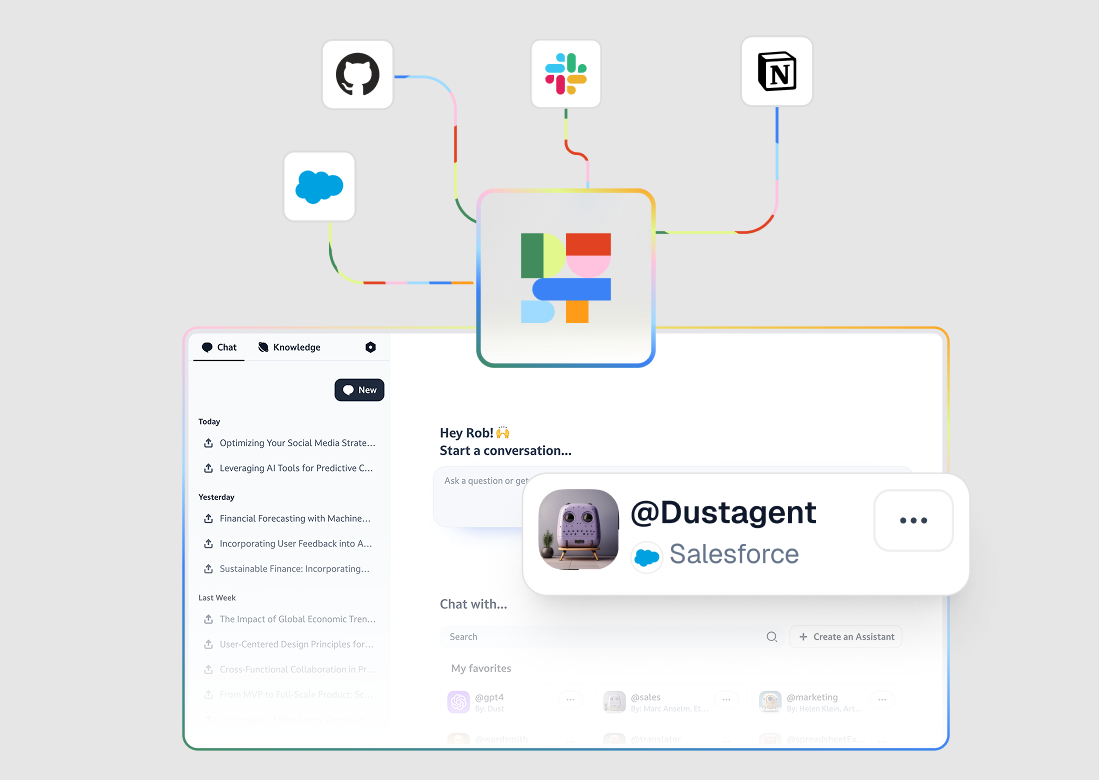
Dust’s platform functions less like a tool and more like an connective tissue for the enterprise. Its intelligence layer integrates with over 100 data platforms, including Slack, Notion, and Salesforce, pulling in the requisite context to make AI agents functionally useful rather than merely generative.
Key to this strategy is the shift in agency:
Non-Technical Deployment: Through its AI operators, Dust enables line-of-business employees to build and deploy agents without requiring engineering oversight, bypassing the bottleneck of technical debt.
Model Agnosticism: By allowing organizations to choose their preferred frontier models, Dust positions itself as a governance and integration layer. This gives firms the flexibility to switch models as the technology evolves without needing to re-architect their workflows.
* Persistent Memory Loops: By processing files and learning from human preferences over time, the platform allows agents to refine their recommendations, moving beyond static responses into proactive, iterative workflow partnership.
Strategic Implications for the Enterprise SaaS Stack
The participation of Snowflake and Datadog in this funding round is highly telling. These companies operate the plumbing of the data economy; their financial involvement suggests they view multiplayer AI as an essential layer in the future enterprise tech stack. If AI is to become the primary interface for business software, it cannot function as an isolated add-on—it must act as an collaborative, persistent participant in the business.
Co-founders Gabriel Hubert, formerly of Stripe, and Stanislas Polu, an ex-OpenAI researcher, are intentionally steering Dust away from the chat-as-product model. Their focus is on building collaboration primitives—the fundamental building blocks for machine-human teamwork.
As the industry moves away from the novelty of AI chatbots, the winners will likely be platforms that can successfully bridge the gap between individual productivity and distributed organizational intelligence. Dust’s push for a shared, governed reality for AI agents represents one of the most credible attempts yet to turn enterprise AI from an experimental project into a fundamental operating system for work.