
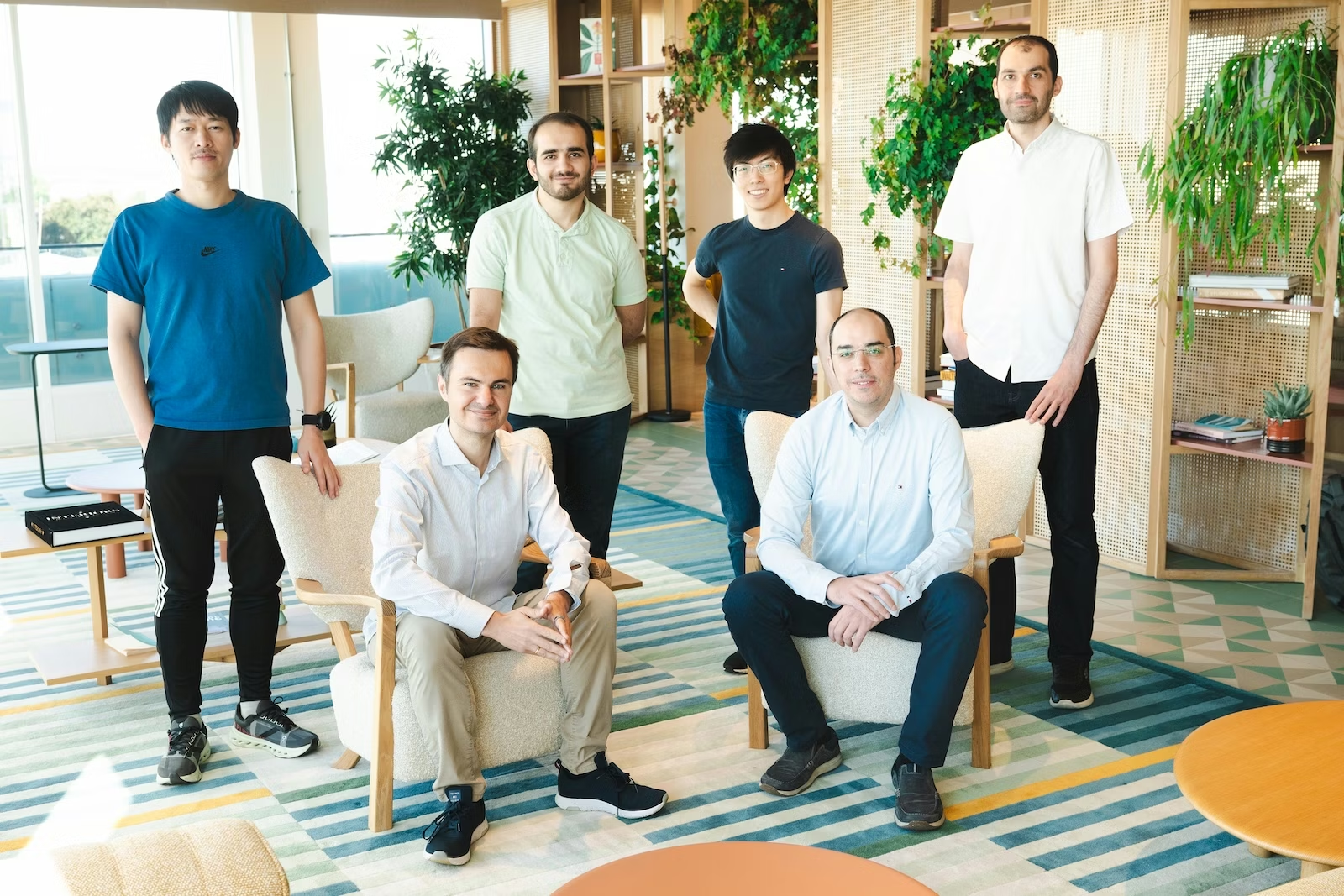
The DeepMind Alumni Diaspora: Silicon Valley’s New Power Brokers
The contemporary venture capital landscape has become defined by a singular, recurring pedigree: the Ex-DeepMind label. While these founders command immediate investor confidence, the recent mass migration of talent from the Google-owned AI titan signals a profound shift in the industry hierarchy. We are witnessing the decentralization of artificial intelligence research, where the former brain trust of one dominant laboratory is now effectively acting as the architects of a fragmented, highly competitive global AI ecosystem.
The Structural Inversion of AI R&D
The exodus of elite researchers from Mountain View is not merely a staffing trend; it is a fundamental realignment of how high-stakes deep tech is funded and developed. As top-tier practitioners depart to launch independent ventures, they take with them not only intellectual property but also the institutional methodologies that propelled DeepMind to global prominence. This migration is actively reshaping the competitive moat. Where once massive, centralized entities enjoyed an insurmountable advantage, the current climate favors nimble, specialized startups that can iterate faster than their legacy counterparts.
A Wave of High-Stakes Spinoffs
The following key players illustrate how this brain drain is actively forming the next generation of AI unicorns:
Mistral AI: Founded by former DeepMind researchers Arthur Mensch, Guillaume Lample, and Timothée Lacroix, the firm has rapidly become the European standard-bearer for generative AI. By securing massive injections of capital—including a $640 million Series B—they are effectively challenging the dominance of US-centric models, proving that localized, high-density talent hubs can successfully compete with Silicon Valley’s giants.
Gemini/Humanloop: The trend toward niche application continues with enterprises like Humanloop, which addresses the critical need for fine-tuning LLMs. By focusing on the developer experience and the refinement of AI models, these firms are solving the usage gap that many massive foundational companies currently suffer from.
* Empowerment through Decentralization: Ventures like Osora and Coherent reflect a broader trend: applying modular AI to specific, high-friction enterprise environments. These firms are moving away from the one model to rule them all philosophy, opting instead to provide specialized infrastructure that integrates directly into existing business workflows—a pivot that is proving significantly more profitable than generic generative efforts.
Industry Implications: The Quality Over Scale Pivot
The primary implication of this industry exodus is a transition away from the bigger is better paradigm that defined the foundational model era of 2022 and 2023. We are entering an era of technical efficiency. Investors are increasingly skeptical of capital-intensive projects that lack clear distribution strategies. Instead, there is a marked preference for teams that prioritize long-term technical defensibility over short-term PR-driven product launches.
Furthermore, the geographical distribution of these startups—ranging from Paris to London and Berlin—indicates that the center of AI innovation is no longer tethered to a single zip code. The Ex-DeepMind network acts as a global connective tissue, facilitating resource sharing and cross-pollination of ideas that circumvent traditional corporate silos.
Ultimately, this migration represents a maturation of the AI market. For the industry at large, the dispersion of these experts serves as a catalyst for innovation. As these former protégés compete to outperform their alma mater, the primary beneficiary is the broader technical landscape. The era of the centralized laboratory is giving way to a more chaotic, competitive, and potentially more productive era of decentralized, hyper-specialized AI development.