
The Shift Toward Modular Agentic Infrastructure
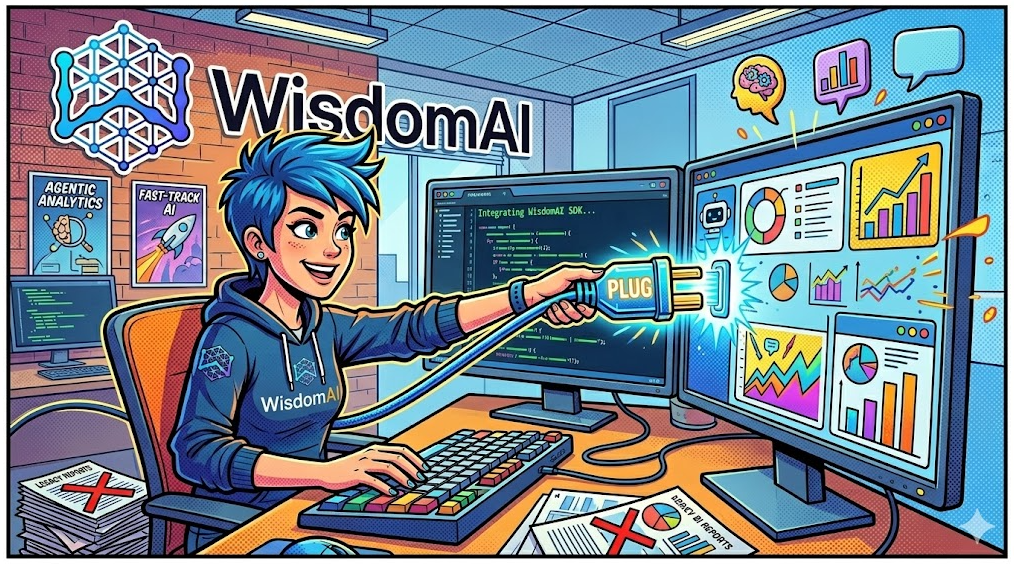
WisdomAI Inc. is pivoting from its origins as an autonomous AI workforce provider to becoming a critical infrastructure layer for the broader software-as-a-service (SaaS) ecosystem. With the launch of Embedded Agentic Analytics, the company is attempting to standardize intelligent data processing, effectively moving the analytics market away from custom, in-house builds toward a buy-over-build model for advanced AI capabilities.
This strategic move addresses a pervasive failure point in the enterprise software market: the high attrition rate of internal analytics initiatives. By offering a white-labeled, plug-and-play architecture, WisdomAI is positioning itself as the Intel Inside for business intelligence, betting that SaaS providers will prefer outsourcing complex data engineering to maintaining fragile, custom-built AI pipelines.
Solving the Why Problem in Business Intelligence
For years, the industry has been trapped in a paradigm of static visualization. Traditional BI tools excel at showing what happened, but rarely provide the granular context required to understand the why. WisdomAI’s approach bridges this gap by leveraging its proprietary Adaptive Context Engine.
This engine is critical because it forces the AI to internalize the specific vocabulary, financial metrics, and operational nuances of a client organization. Unlike generic LLM-based analytic tools, this context-aware approach mitigates the hallucinatory inaccuracies that have plagued early attempts at conversational BI. By enabling users to drill down into unstructured data—such as PDF reports and internal knowledge bases—alongside traditional relational databases, WisdomAI transforms static dashboards into interactive, diagnostic ecosystems.
Reducing Friction via Deployment Flexibility
The technical challenge for any white-labeled solution is balancing ease of integration with architectural control. WisdomAI manages this by offering a tripartite deployment model:
iFrame implementations: Optimized for rapid, lightweight deployments that prioritize speed to market.
React SDK: Designed for deeper, native-feeling integrations within existing application workflows.
* GraphQL API: Reserved for enterprise architectures requiring a high degree of UI customization and backend orchestration.
By supporting a governed MCP (Model Context Protocol) endpoint, the company ensures that its analytics layer is not a silo. It allows third-party AI agents to interface directly with the data, effectively turning the analytics platform into an interoperable API that contributes to an organization’s broader autonomous ecosystem.
Enterprise Security and the Buy-over-Build Paradigm
The adoption by major firms like Blend Labs, which handles over $1.3 trillion in loan applications, highlights the current market demand for enterprise-ready AI. Blend’s decision to integrate WisdomAI rather than dedicating years to internal R&D signals a maturing market preference.
Security remains the primary barrier to entry for third-party AI integration. To address this, WisdomAI emphasizes single-tenant virtual private cloud deployments and bring your own LLM (BYO-LLM) configurations. By isolating customer data and ensuring it is never used to train global, multi-tenant models, WisdomAI removes the compliance friction that typically prevents large-scale SaaS providers from adopting high-performance AI analytics.
As SaaS vendors continue to fight for user retention, the ability to offer advanced, conversational data insights without diverting core engineering resources to data science projects will likely become a critical differentiator. WisdomAI is betting heavily that this shift in resource allocation will define the next generation of enterprise software applications.