
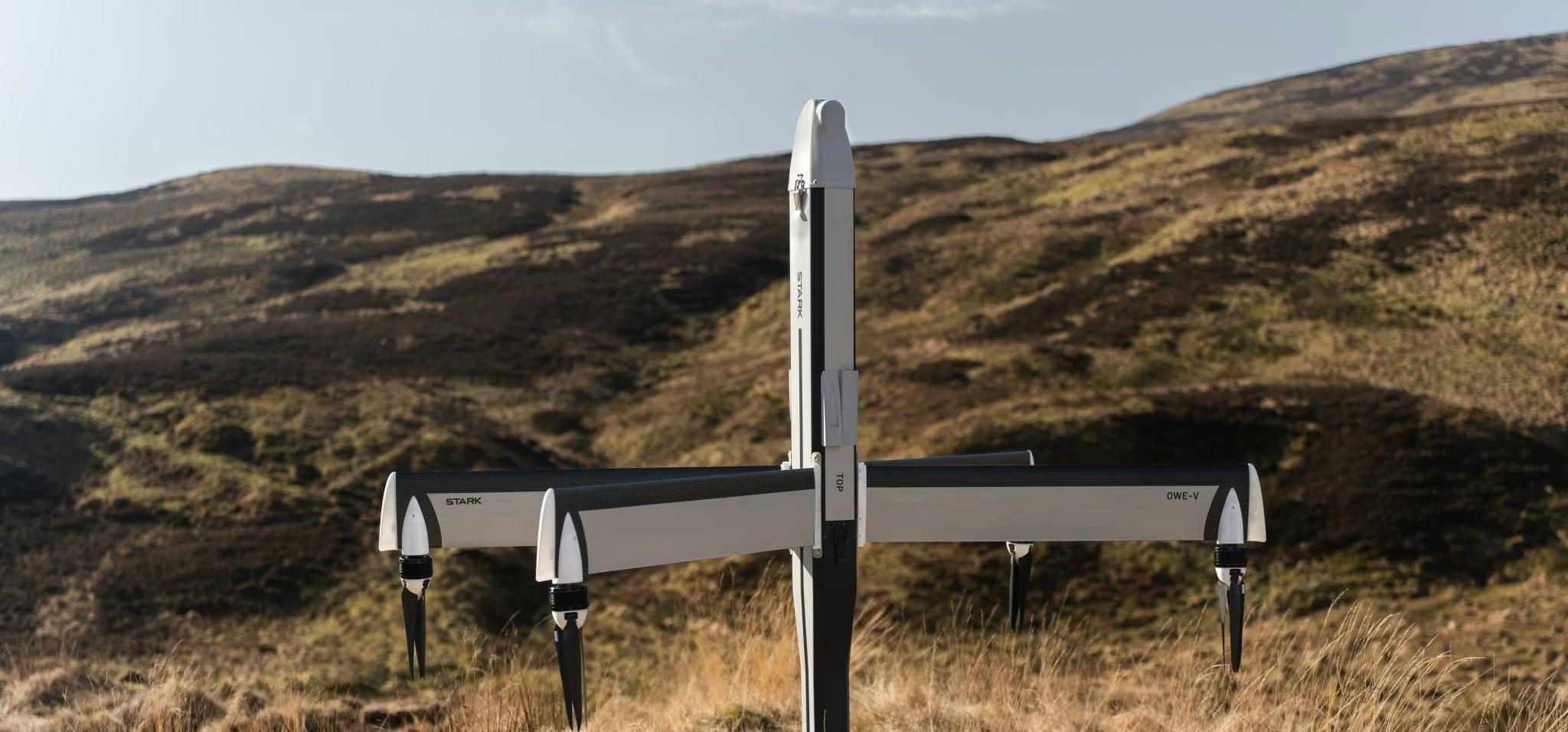
The Rising Valuation of Defense-Tech
Berlin-based aerial strike drone manufacturer Stark is currently engaged in high-stakes negotiations for a significant new capital infusion. According to industry insiders, the company is poised to secure a substantial funding round that signals both the company’s rapid scaling and the broader institutional appetite for European defense-tech.
Founded in 2020 by former Formula One engineer Jörg Müller, Stark has transformed from a niche aerospace project into a central player in the European military technology sector. The company’s focus on autonomous, software-defined weaponry aligns with a global pivot toward agile, cost-effective defense hardware. Stark counts prominent venture capital firms among its backers, including Berlin-based Project A, the NATO Innovation Fund, and Earlybird.
Market Sentiment and Strategic Positioning
Industry analysts suggest this upcoming financing could value Stark at upwards of $1 billion. This valuation shift represents a staggering trajectory for the startup, which has previously benefited from strong investor enthusiasm during earlier funding cycles. In previous years, the company secured a $30 million round led by Project A and the NATO Innovation Fund, a testament to the strategic importance assigned to drone warfare in the wake of shifting geopolitical landscapes.
The current funding objective appears driven by the need for increased production capacity. As conventional industrial supply chains struggle to meet the surge in demand for strike-capable drones, startups like Stark are being forced to scale manufacturing at a rapid, almost unprecedented pace. With existing valuation benchmarks already hovering near the €300 million mark, a successful completion of this latest round would solidify Stark’s status as one of Europe’s most valuable defense-tech unicorns.
Geopolitical Implications for Venture Capital
The involvement of the NATO Innovation Fund underscores how defense-tech has graduated from a speculative niche to a cornerstone of institutional investment. Stark’s strategic advantage lies in its lean, design-focused approach to drone production, which mimics the technical efficiency of the automotive and racing industries rather than the lumbering timelines of legacy defense contractors.
This shift in capital allocation reflects a broader trend: the Silicon Valley-fication of European defense. By integrating software-centric development cycles, companies like Stark are positioning themselves to provide modular, upgradeable hardware that can outperform traditional, high-cost defense platforms.
Leadership and Regional Consolidation
Internal growth is occurring alongside external expansion. Stark has recently bolstered its executive leadership, recruiting top talent from the aerospace and aviation sectors to guide its transition into full-scale mass production. Notably, the firm has strengthened its presence within the German defense ecosystem by appointing industry experts to key operational roles, ensuring that its technology meets the stringent integration requirements demanded by regional security partners.
As Stark approaches this financial milestone, the market is watching closely. If the company secures its target valuation, it will validate the potential for European defense startups to compete directly with global incumbents. For investors, the takeaway is clear: the future of national security is being written by software-native organizations capable of iterating at the speed of modern code.