
The Maturity of European Robotics: Capital Influx and Strategic Shifts
The European robotics sector has transitioned from a period of experimental research to one of aggressive commercial scaling. Recent data confirms a significant acceleration in investment, with funding for the continent’s robotics startups doubling in 2025 to reach €1.45bn. With over €522 million secured within the first quarter of the year alone, the sector is clearly carving out a dominant industrial niche.
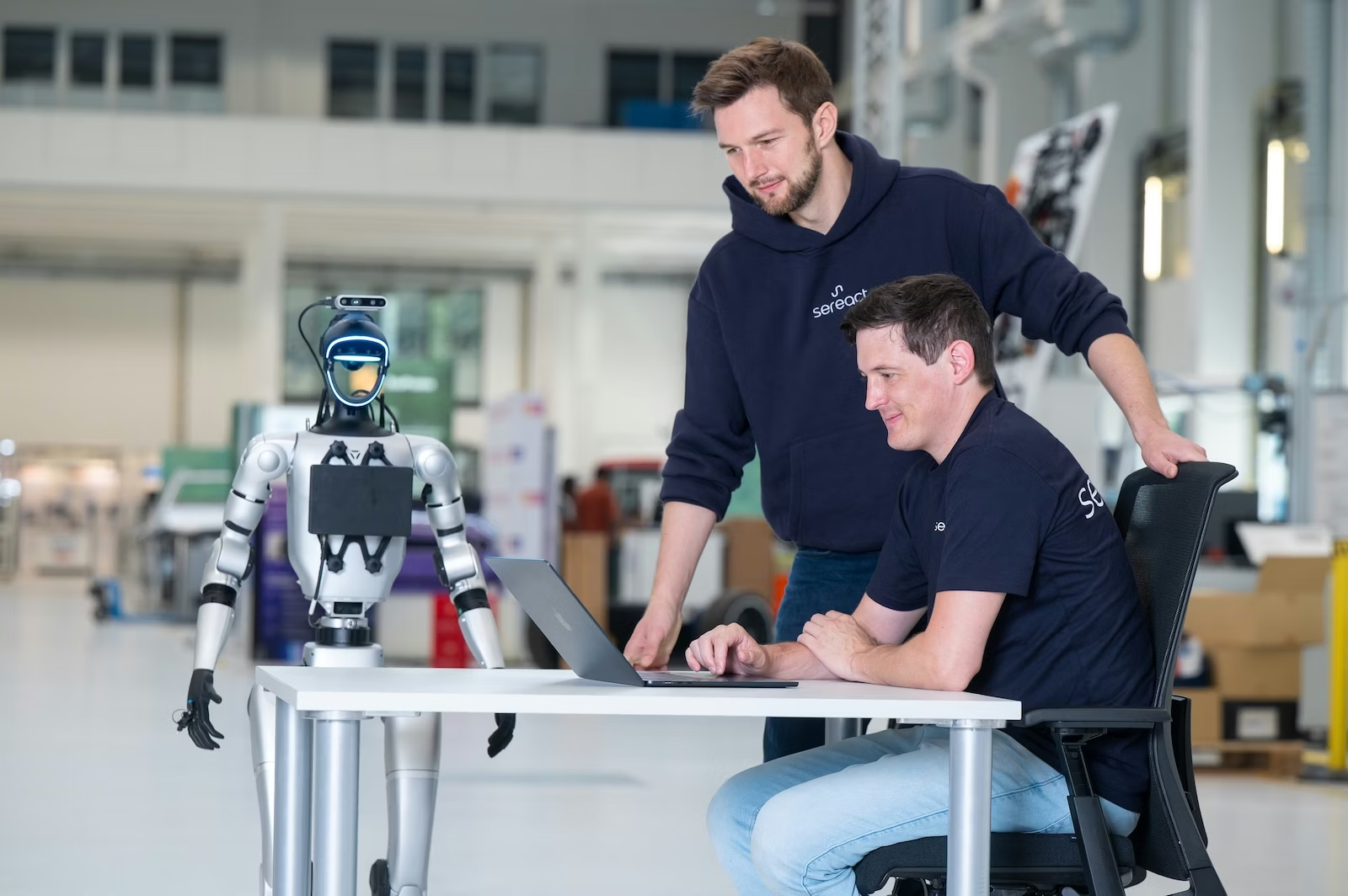
Stuttgart-based Sereact sits at the epicenter of this shift, recently closing a $110 million Series B round led by Headline, with follow-on support from Air Street Capital, Creandum, and Point Nine. This brings the company’s total venture funding to $140 million, signaling investor confidence not just in the hardware, but in the underlying intelligence stacks that drive modern automation.
Decoding the VLA Advantage: Beyond Simple Object Picking
At the core of Sereact’s value proposition is Cortex, a vision-language-action (VLA) model designed to be hardware-agnostic. While contemporary robotics often suffers from fragmented development—where specific software is coded for specific controllers—Sereact’s approach decouples the brain from the body.
Initially deployed to optimize warehouse fulfillment workflows, the company is now pivoting toward higher-order industrial autonomy. The transition from Cortex to the incoming Cortex 2 represents a fundamental shift in machine intelligence. While the original iteration focused on basic visual recognition and object manipulation, Cortex 2 integrates a world model.
This transition signifies a move from pattern matching to environmental reasoning. By modeling the physical constraints and causal relationships of a workspace, the system can handle complex manufacturing tasks, such as tension-stressed assembly and sensitive automotive component integration, without requiring a rigid, pre-programmed script.
The Data Flywheel as an Industrial Moat
The industry’s race to solve embodied AI—bringing foundation models into the physical world—is being won by firms that prioritize real-world testing over simulated laboratory environments. Sereact’s deployment of over 200 systems, having processed more than 1 billion production picks for blue-chip clients like BMW, Daimler Truck, and PepsiCo, provides a distinct competitive advantage.
CEO Ralf Gulde’s philosophy centers on the data flywheel. By integrating directly into high-stakes production lines, Sereact captures edge-case data that synthetic simulations cannot replicate. In the robotics world, the ability to observe, learn from, and iterate upon real-world failures is the ultimate barrier to entry. This feedback loop ensures that the software improves with every action, turning the company’s installed base into a proprietary data engine.
Expanding the Frontier: The Transatlantic Pivot
The $110 million injection is not merely for R&D; it signals an operational pivot into the United States. Establishing a presence in Boston—a global hub for robotics and talent—positions Sereact to challenge domestic US incumbents directly. By hiring local engineering and commercial teams, they are moving to localize their supply-chain integration capabilities.
As the industry matures, the race for world models is becoming the new gold standard for industrial robotics. If European firms like Sereact can successfully leverage their robust, data-backed models to solve the chaotic, unscripted problems of high-speed manufacturing, they may well control the software architecture that defines the next generation of global industrial production.