
The Shift Toward Local AI Orchestration
As the foundational model landscape hits a state of commoditization, the industry’s center of gravity is shifting away from model training and toward the software layers that facilitate interaction. Startups are increasingly focused on interoperability, aiming to solve the vendor lock-in problem inherent in relying solely on closed, proprietary cloud APIs.
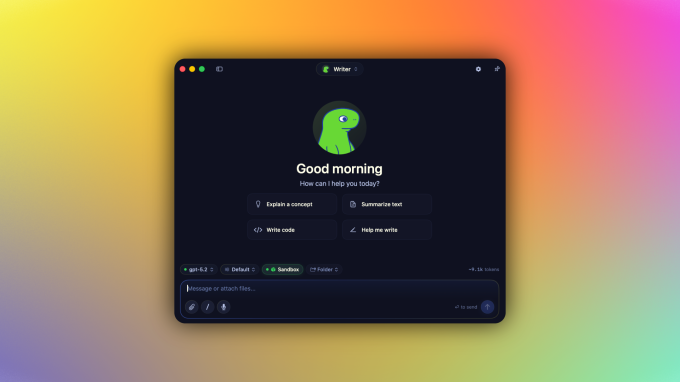
Osaurus, an Apple-centric open-source AI server, represents a strategic move toward local orchestration. By positioning itself as a universal harness, it allows users to swap between various local and cloud-hosted Large Language Models (LLMs) while maintaining data sovereignty over local files and automation workflows. This architecture directly addresses the primary pain point of current AI adoption: the friction between high-performance model versatility and rigorous privacy requirements.
From Desktop Companion to Model Harness
Osaurus originated from the pivot of Dinoki, a desktop AI-powered interface. The founders discovered a clear market resistance among users who were hesitant to tether their workflows to ongoing token costs. This realization underscored a broader industry trend: users are seeking fixed-infrastructure solutions where the intelligence utility is decoupled from consumption-based billing.
Unlike existing technical tools often geared toward software developers comfortable with terminal interfaces, Osaurus prioritizes consumer-grade accessibility. It delivers a hardware-isolated, sandboxed execution environment that mitigates the security risks often present in less mature CLI-based automation tools. For industries handling sensitive data—such as legal, finance, and healthcare—this sandboxing capability offers a necessary level of risk mitigation that cloud-only solutions cannot natively provide.
Bridging Hardware Limitations and Model Efficiency
The current adoption of local AI remains constrained by the thermal and memory overhead of Apple Silicon hardware. High-tier performance currently requires significant RAM allocation—specifically the 64GB to 128GB range required for robust models like DeepSeek v4.
However, the rapid advancement in “intelligence per watt” metrics suggests that these hardware barriers are temporary. As model distillation, quantization, and specialized inference runtimes improve, the necessity for massive onboard memory will likely diminish. Osaurus is effectively betting on the long-term convergence of on-device efficiency and model capability. By incorporating comprehensive support for the Model Context Protocol (MCP), it enables seamless communication between the model and host-level utilities, ranging from browser interaction to calendar management and filesystem access.
Challenging the Data Center Paradigm
The long-term implication of projects like Osaurus is a potential redefinition of AI infrastructure. By enabling enterprises to deploy consolidated hardware—such as a Mac Studio—to handle heavy-duty AI tasks on-premises, Osaurus posits an alternative to massive, energy-intensive data centers.
This model of Edge AI, where intensive processing happens at the point of use rather than within a centralized cloud farm, offers clear advantages in speed and power efficiency. With over 112,000 downloads and a roadmap that includes enterprise-grade security features, the Osaurus team is effectively challenging the assumption that generative AI must be synonymous with cloud-based computation. As local models bridge the gap to enterprise-tier performance, the ability to control the execution environment without sacrificing model agility will become a critical differentiator in the next wave of AI adoption.