
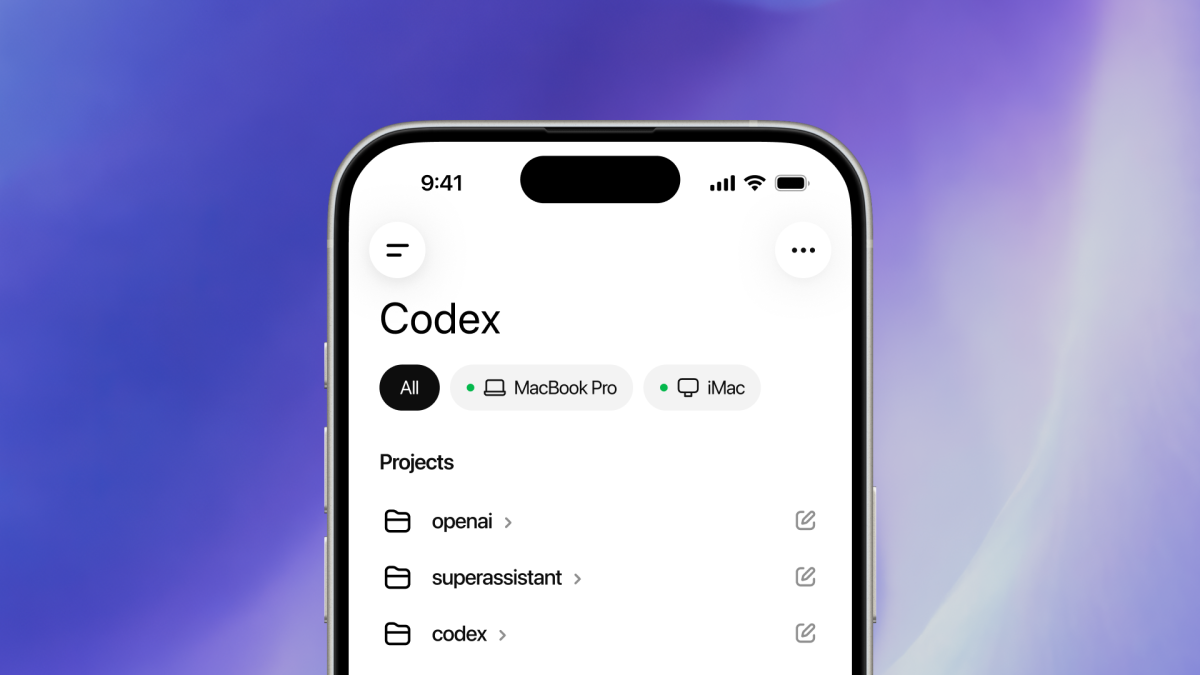
The Pivot to Ambient Computing in Software Development
OpenAI has officially transitioned its Codex technology from a desktop-tethered utility to a mobile-native development companion. By integrating Codex directly into the ChatGPT mobile application, OpenAI is fundamentally altering the developer’s relationship with their workspace. This update, now available across iOS and Android, moves beyond simple notification systems; it provides a comprehensive control plane for software engineers on the move.
The technical implications of this release are significant. Users can now monitor live coding environments, manage active threads, execute commands, and toggle between different language models remotely. This shift recognizes that professional development is no longer confined to desk-bound static sessions. Instead, it reflects an emerging ambient development environment where the AI agent maintains operational continuity regardless of whether the user is in front of a primary station or navigating a mobile interface.
The Race Toward Autonomous Agentic Workflows
This mobile expansion is the latest tactical maneuver in a broader conflict between OpenAI and Anthropic. The industry is currently witnessing a rapid migration from simple code-assistance chatbots to fully autonomous agentic architectures. OpenAI’s recent enhancements—including background execution for desktop environments and the introduction of a Chrome extension for browser-based task automation—demonstrate a commitment to a persistent agent model.
The strategy is clear: OpenAI aims to transform Codex into an ever-present digital coworker that handles heavy lifting in the background, only surfacing to the mobile app when human oversight or decision-making is required. This effectively reduces the latency of intent, where a developer can resolve a deployment error or iterate on a function while commuting or away from their primary machine.
Competitive Pressures and the Proliferation of Remote Control
The competitive landscape is heating up significantly. Anthropic’s recent deployment of its Remote Control feature for Claude Code underscores an industry-wide consensus: the ultimate winner of the AI coding wars will be the tool that offers the highest level of trust and administrative control. By enabling remote monitoring of autonomous processes, both firms are attempting to alleviate the primary bottleneck to AI adoption in professional engineering: the fear of unchecked agentic execution.
As these tools gain ground, businesses are increasingly decoupling their development workflows from localized hardware. Anthropic has seen meaningful traction with technical teams by emphasizing stability and developer-centric workflows. OpenAI’s decision to bring the full weight of ChatGPT’s mobile ecosystem into the coding lifecycle is a direct response to this rivalry, aiming to capture the developer segment by offering the most frictionless, ubiquitous, and high-fidelity interface currently on the market.
Ultimately, this trend signals a paradigm shift. We are moving toward a future where writing code is secondary to orchestrating agents. As these capabilities mature, the developer’s role will shift toward architecture, review, and high-level strategy, while the actual implementation of logic becomes an increasingly mobile, background-driven affair.