
Strategic Mineral Autonomy: Lithosquare’s $25M Seed Round Marks a Shift in Exploration Tech
Paris-based startup Lithosquare has secured a $25 million equity seed round to scale its AI-driven mineral exploration platform. The funding, co-led by World Fund and Kindred Capital with participation from European heavyweights including Daphni, Omnes Capital, and Ovni Capital, underscores an intensifying institutional appetite for technologies that secure the energy transition’s supply chain.
As the global push for decarbonization accelerates, the bottleneck for electric vehicle (EV) battery production, grid storage, and consumer electronics has shifted downstream from manufacturing to raw material sourcing. With critical metals like lithium, copper, and nickel currently subject to severe geographical concentration—most notably China’s near-monopoly on rare earth refinement—Western economies are treating mineral resource discovery as a matter of national security rather than a purely commercial endeavor.
Moving Beyond Pattern Recognition in Geology
Traditionally, AI in mining has been constrained by the limitations of supervised machine learning. Conventional models act as sophisticated pattern-matchers, scanning historical geological data to locate anomalies that resemble previously discovered deposits. While efficient for expanding known mining districts, this approach suffers from a profound bias: it can only identify what has already been found, effectively ignoring greenfield sites in unexplored regions.
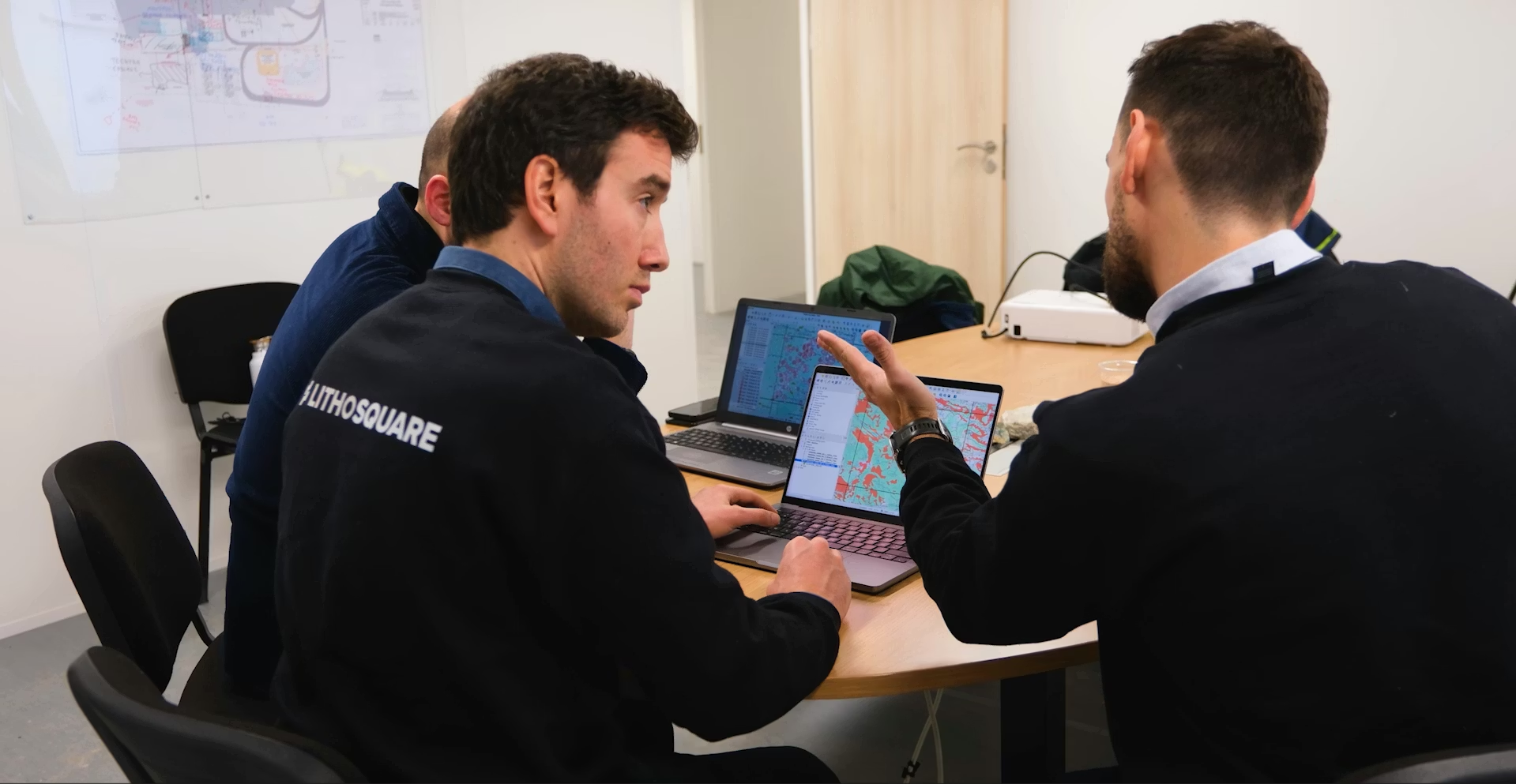
Lithosquare aims to break this paradigm with a foundational AI model. By training its architecture on multimodal datasets—synthesizing satellite imagery, textual geological reports, geochemical surveys, and geophysical indices like magnetism and radioactivity—the company is attempting to encode the actual science of geology.
This enables their platform to function as a collaborative partner for geologists, allowing for the formulation and testing of novel hypotheses. By moving away from restrictive pattern recognition toward a broader, generative understanding of geological signatures, Lithosquare claims to reduce the analytical phase of exploration from several months to a mere matter of days.
Addressing the Sovereignty Imperative
The timing of Lithosquare’s capital injection aligns with legislative pivots, most notably the EU’s Critical Raw Materials (CRM) Act. By mandate, Europe is seeking to domesticate at least 10% of its consumption and diversify its import dependencies by 2030.
For mining firms, this creates a dual-pressure environment: the need to operate with higher margins in volatile price markets and the regulatory requirement to de-risk supply chains. Lithosquare’s business model is structured to align with these needs, utilizing a hybrid revenue framework that includes baseline service fees for mapping and deposit identification, supplemented by performance-based milestones and long-term revenue-sharing agreements on eventual production.
Scaling in a Competitive Landscape
Lithosquare is entering a high-stakes, capital-intensive race. While it faces stiff competition from unicorns like the Bill Gates-backed KoBold Metals, which achieved a $3 billion valuation on the back of its own AI exploration tools, the market remains severely underserved. The sheer geographic scale of the transition—requiring thousands of new, viable mine sites—suggests that there is ample room for regional leaders.
To maintain its competitive edge, the startup has announced an aggressive scaling phase. The company plans to double its headcount to 40 employees and establish a North American office. This expansion is tactical; moving closer to the North American mining ecosystem will grant Lithosquare better access to the capital, expertise, and operational footprints required to challenge incumbent giants.
For the mining sector, the shift toward AI is no longer optional. As the easy-to-find, surface-level deposits near physical exhaustion, the industry is transitioning into the deep tech era. Lithosquare’s success will ultimately be measured by its ability to prove that its foundational model doesn’t just process data, but identifies the high-grade, deep-seated deposits that will fuel the next century of industrial energy demand.