
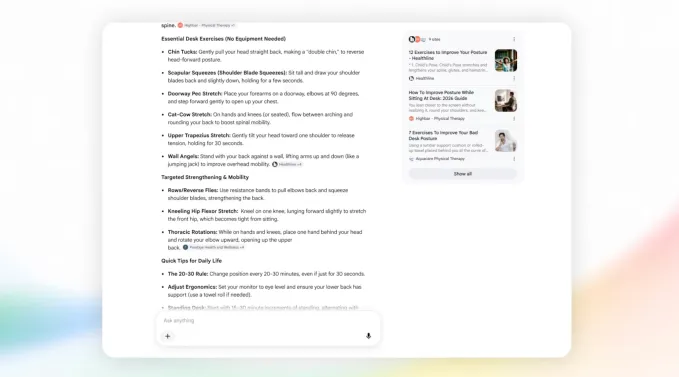
The Paradigm Shift: Google’s Transition from Indexing to Orchestration
Google’s latest unveiling at I/O marks the definitive end of the ten blue links era. By transitioning from a retrieval-based search engine to an agentic, generative interface, Google is fundamentally redefining the relationship between the user, the web, and the primary gateway to digital information. For over two decades, the search experience focused on navigating the user to a destination; today, Google is positioning itself as the destination itself.
By integrating generative UI and persistent, stateful interactive experiences, Google is moving toward a model where it no longer functions as a conduit for web traffic, but as a synthesis engine. This shift from simple query-and-response to dynamic, context-aware interaction fundamentally threatens the underlying economic structure of the open web, which relies on consistent outbound traffic to sustain publishing ecosystems.
The Rise of Agentic Search and Generative UI
The introduction of information agents is perhaps the most significant departure from legacy search. These background processes, powered by Google’s Gemini Flash 3.5 model and the Antigravity development platform, indicate a shift toward proactive, rather than reactive, computation. Instead of a human manually querying and scanning results, Google is now facilitating software that monitors, synthesizes, and alerts users.
This is not merely an upgrade to Google Alerts; it is the democratization of specialized automation. By allowing users to construct mini-apps through natural language, Google is essentially becoming a low-code platform for intent-based operations. Whether for fitness tracking or sector-specific market analysis, the search box is evolving into a personal operating system. For developers and SaaS providers, this presents a significant challenge: Google is effectively internalizing the functionality that previously required dedicated software or external web properties.
Implications for the Publisher Ecosystem and SEO
Industry analysts must recognize that the Search nomenclature is quickly becoming a misnomer. If the platform prioritizes AI Overviews and generative widgets that aggregate data into a final, consumable form, the marginal utility of clicking through to a source website drops precipitously.
While Google claims these changes increase user engagement—noting over 2.5 billion monthly users for AI Overviews—the zero-click trend represents an existential crisis for digital publishers. Ad-dependent businesses, which have already seen traffic erosion since the initial deployment of AI-generated summaries, now face a future where their content serves primarily as training material for the very systems displacing their existence.
Strategic Outlook: The Battle for User Intent
Google’s strategy is clear: increase the stickiness of the search experience by minimizing the need for navigation. By providing stateful, personalized environments that users can return to repeatedly, Google is deepening its defensive moat against competitors like OpenAI.
However, this transition introduces a new strategic risk: the degradation of the open web. As the incentive for content creators to produce high-value information wanes in the face of declining referral traffic, the quality of both the training data and the synthesized answers risk stagnation. As Google moves to monetize these capabilities through AI Premium tiers while simultaneously offering them as free, mass-market tools, the company is betting that the efficiency of AI-driven synthesis will ultimately outweigh the loss of the traditional hyperlink ecosystem. For the rest of the industry, the race to pivot away from a reliance on search-driven acquisition is now critical.