
The Maturation of Crypto-Compliance: Elliptic’s $120 Million Infusion
Elliptic Enterprises Ltd. has successfully secured $120 million in a Series D funding round, bringing the blockchain analytics firm’s valuation to a reported $670 million. Led by growth equity firm One Peak, the round saw strategic participation from institutional heavyweights including Nasdaq Ventures, Deutsche Bank, and the British Business Bank. This capital injection underscores a pivotal trend: the traditional financial sector is no longer treating cryptocurrency as an outlier, but rather as one of the most critical frontiers for enterprise risk management.
Engineering Trust in a Decentralized Infrastructure
At the core of Elliptic’s market proposition is its Data Fabric platform. By synthesizing over 21 million daily cryptocurrency transactions with over a decade of historical blockchain data, the company has built a comprehensive intelligence layer.
For institutional players, the primary challenge is not the blockchain itself, but the lack of unified visibility into the origins and destinations of capital. By distilling vast datasets into actionable intelligence, such as databases of sanctioned wallet addresses, Elliptic allows traditional banks to integrate digital asset monitoring directly into their existing fraud-prevention frameworks. This effectively bridges the gap between legacy compliance regimes and the fluid, often opaque, nature of decentralized finance.
Operational Efficiency as a Compliance Necessity
The true value of Elliptic’s ecosystem lies in its ability to decrease the time-to-compliance for digital asset exchanges and stablecoin issuers. Modern regulatory requirements demand near-real-time monitoring, a task that manual review teams cannot sustain as transaction volumes scale.
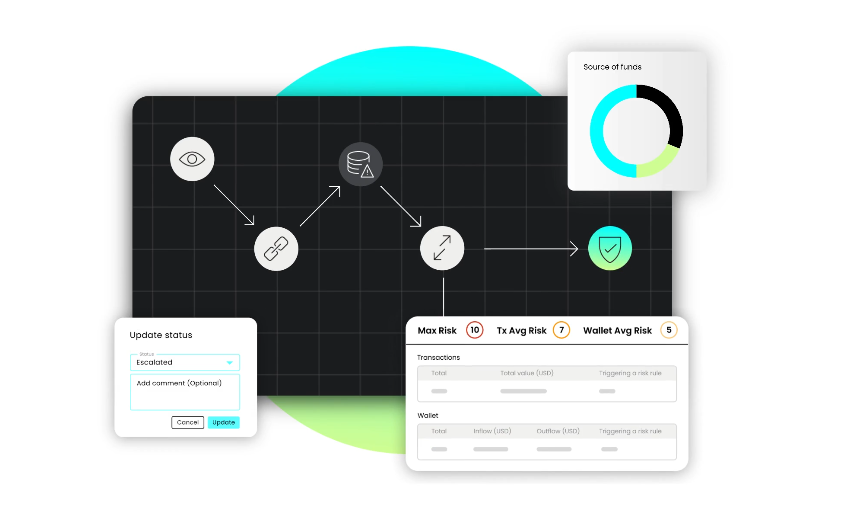
The company’s Lens product shifts the burden from manual oversight to automated alerting. By providing context-rich data—such as specific counterparty information and the reasoning behind a flagged transaction—within a streamlined interface, Elliptic allows compliance teams to resolve threats in under five minutes. This efficiency is critical for exchanges that must mitigate illicit activity without creating unnecessary friction for legitimate users.
Addressing the Complexity of Cross-Chain Transgressions
As bad actors increasingly utilize cross-chain shuffling to obscure fund trails, simple monitoring tools are no longer sufficient. Elliptic’s Investor tool addresses this by automating the visualization of asset movement across fragmented blockchain ecosystems. By generating automated graphs of complex transaction pathways, the software reduces the time required for forensic investigations by 30%.
Furthermore, the Analytics suite empowers institutions to perform proactive due diligence. Exchange operators use these visualization tools to evaluate the health and risk profiles of new assets before listing them, effectively performing security audits on liquidity and historical illicit patterns. This capability is essential as crypto-assets become increasingly embedded in global financial systems.
Industry Implications: The Institutionalization of Blockchain Intelligence
The participation of Nasdaq Ventures and Deutsche Bank in this round is highly indicative of the current state of the industry. These entities are not merely investing in a software startup; they are investing in the infrastructure essential for the institutional adoption of digital assets.
With a footprint covering over 700 organizations, including exchanges responsible for over two-thirds of global crypto-transaction volume, Elliptic has positioned itself as a de facto utility layer. As global regulators continue to increase their scrutiny of the crypto-asset class, tools that can prove auditable compliance and identify malicious activity are shifting from optional value-adds to mandatory core systems. The growth of Elliptic signals that the Wild West era of cryptocurrency is steadily giving way to an era of professional, high-velocity, and rigorously monitored financial infrastructure.