
The Orbital Pivot: Why Cowboy Space Corp’s $275 Million Bet Matters
Cowboy Space Corp., formerly known as Aetherflux, has secured $275 million in a Series B round led by Index Ventures, pushing its valuation to a notable $2 billion. With total funding now reaching $355 million and participation from tech heavyweights including Robinhood co-founder Baiju Bhatt, the company is signaling a high-stakes shift in the space-compute sector.
Originally conceived as a wireless power transmission startup, Cowboy Space has rebranded and pivoted toward a more aggressive objective: deploying artificial intelligence data centers directly into low-Earth orbit (LEO). This move reflects a growing industry consensus that the terrestrial constraints of power density—limited by atmospheric absorption and the fluctuating angle of solar incidence—are insufficient for the next generation of power-hungry AI workloads.
Solving the Power-Compute Paradox
The fundamental thesis behind Cowboy Space is simple: physics favors orbital computing. Terrestrial solar farms operate under the constraints of weather, diurnal cycles, and atmospheric filtering. In orbit, solar arrays maintain constant, perpendicular orientation to the sun, generating energy at an efficiency rate terrestrial grids struggle to approximate.
By leveraging this constant power influx, Cowboy Space aims to circumvent the energy bottlenecks currently throttling terrestrial hyperscalers. The company plans to integrate Nvidia’s Space-1 Vera Rubin modules—specialized hardware combining 88-core CPUs with high-performance Rubin GPUs—to facilitate edge-of-space AI processing. At 50 petaflops of performance per chip, this hardware demonstrates that the objective is not just existence in space, but high-utility, high-throughput machine learning.
Vertical Integration and Hardware Efficiency
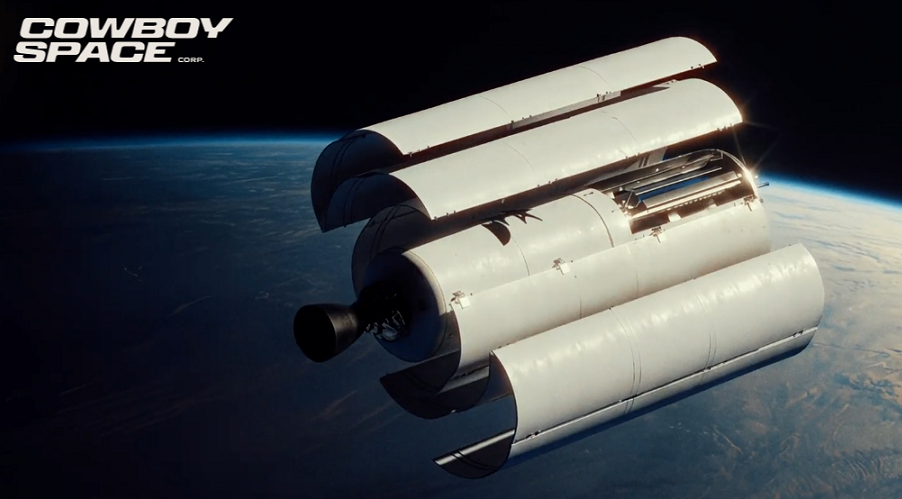
Cowboy Space distinguishes itself through a unique engineering approach: dual-purpose design. Rather than discarding the second stage of their proprietary launch vehicles after deployment, the company plans to repurpose these stages as data center containers. This reconfigurability is a critical strategy to mitigate the prohibitive costs of orbital logistics.
By eliminating the waste of expendable hardware, Cowboy Space is attempting to solve the biggest economic barrier to space-based infrastructure: the high cost per kilogram of orbital delivery. However, at a 1-megawatt capacity per module, the startup faces a scaling hurdle. To compete with the aggregate compute capacity of terrestrial cloud availability zones, the firm must master inter-module communication. Whether this is achieved through structural clusters or high-bandwidth laser cross-links remains a pivotal technical unknown.
The Competitive Landscape and Market Implications
The race for orbital dominance is intensifying. Cowboy Space joins a nascent but competitive field, including rivals like Starcloud Inc., which envisions massive, sprawling support structures for multi-module satellite arrays.
Furthermore, the shadow of SpaceX looms large. With the development of launch vehicles featuring reusable second stages capable of carrying 150 tons—a payload capacity dwarfing current industry standards—SpaceX is positioned to become the primary gatekeeper of this ecosystem. If SpaceX executes its own plans for orbital AI infrastructure, startups will need to prove that their specific integration with specialized chipsets like the Rubin module offers value beyond pure processing power.
The success of Cowboy Space hinges on its ability to transcend the novelty of orbital computing and provide a tangible, reliable alternative to data centers that remain tethered to the power demands of the grid. As the company prepares for its inaugural launch next year, the industry will be watching to see if this marriage of sustainable solar power and high-end Nvidia silicon can fundamentally rewrite the economics of global AI training and inference.