
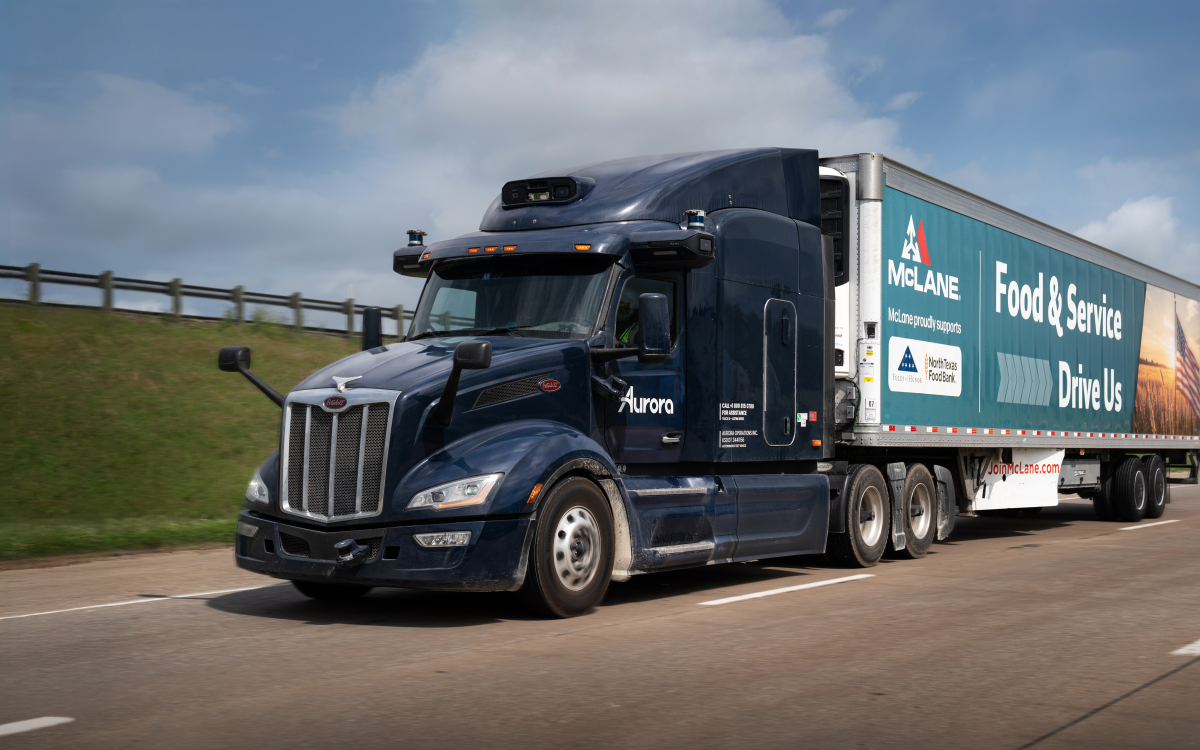
From Prototype to Utility: The Professionalization of Aurora Innovation
Aurora Innovation has transitioned its collaboration with supply chain giant McLane from a speculative pilot to a permanent, revenue-producing commercial operation. This move marks a definitive graduation from technical proof-of-concept projects to a scalable, real-world logistics utility. By establishing consistent, unmanned operations across the high-traffic Dallas-Houston corridor via the Aurora Horizon platform, the company is signaling to the broader transportation market that autonomous trucking is officially transitioning from an experimental venture to an industrial necessity.
Operational Pragmatism via the Hybrid Relay Model
The logistical architecture adopted by Aurora and McLane sidesteps the most persistent hurdle facing autonomous technology: the unpredictability of urban driving. By utilizing a hub-to-hub relay system, Aurora isolates its AI performance to long-haul, freeway-dominant transit. These routes offer the controlled variables necessary for current-generation autonomy, such as predictable lane markings and steady speeds, while leaving the high-friction, last mile complexity of city streets to human operators.
This segmentation is not merely a technical workaround; it is a business model optimization. By keeping autonomous assets moving on highway segments, logistics managers can bypass the restrictive federal hours-of-service mandates that currently limit human productivity. This results in significantly higher vehicle utilization rates, effectively decoupling freight capacity from the availability of human long-haul drivers.
The Strategic Function of Human Supervision
While Aurora labels these deployments as driverless, the inclusion of a human monitor in the cabin represents a calculated approach to risk management and data acquisition. These monitors function less as operators and more as safety engineers, providing the critical human-in-the-loop oversight necessary to satisfy insurance underwriters and regulatory scrutiny.
Beyond safety, these personnel are essential for iterative software development. The diagnostic data gathered during these supervised runs provides the engineering team with granular insights that simulated environments cannot replicate. As the software matures, this supervised layer will likely serve as the final filter before the industry transitions to fully cabin-empty, Level 4 operations.
Capital Commitment: The Rise of Hardware-as-a-Service
The shift in market sentiment is perhaps best reflected in the financial commitments from major freight carriers like Hirschbach Motor Lines and Detmar Logistics. We are seeing a move away from exploratory R&D spending toward concrete fleet procurement. Aurora is positioning itself as the critical infrastructure layer—the virtual driver—rather than attempting to compete as a traditional freight carrier.
By integrating their stack into Paccar vehicles, Aurora is establishing a Hardware-as-a-Service (HaaS) ecosystem that integrates seamlessly into legacy logistics operations. This interoperability is key; it allows legacy firms to adopt autonomous technology without rebuilding their entire supply chain, effectively commoditizing the driving task across a standardized vehicle platform.
Competitive Realignment: The Economic Stakes
The push into high-traffic Sun Belt corridors acts as a stress-test, allowing Aurora to build a proprietary data moat that deepens with every mile. The economic implications for the freight industry are seismic. If Aurora achieves sustained, wide-scale operational efficiency, the market will face an inevitable wave of industry consolidation.
Traditional carriers that lack the capital or the infrastructure to integrate autonomous technology will be increasingly disadvantaged by the operational cost advantages of their automated peers. The long-term trajectory suggests that the future of freight economics will favor those who shift from a labor-heavy model to an infrastructure-heavy approach, effectively turning the highway driver into a specialized, and perhaps less frequent, role in the broader logistics chain.