
The Infrastructure Paradox: Why GPU Interconnects Are the New AI Scaling Ceiling
The trajectory of generative AI has shifted from a narrative of pure silicon performance to one defined by systemic orchestration. As large language models (LLMs) break through the multitrillion-parameter barrier, the fundamental architecture of the modern data center is buckling under the weight of its own success. We have arrived at an era where the bottleneck is no longer just the FLOPS capacity of a single GPU, but the ability of the underlying network to supply those chips with high-velocity data.
Currently, the industry relies on massive, distributed clusters that mimic the behavior of a singular supercomputer. However, this transition has introduced a massive economic and technical data tax. As data travels across the physical expanse of thousands of connected GPUs, latency becomes the primary enemy of efficiency. When expensive, Tier-1 AI accelerators sit idle waiting for network fabric to resolve overhead, the cost-per-inference skyrockets. Solving this requires more than just faster silicon; it necessitates a radical rethinking of how data centers move information.
Memory-Semantic Fabrics: Resolving the Latency Deficit
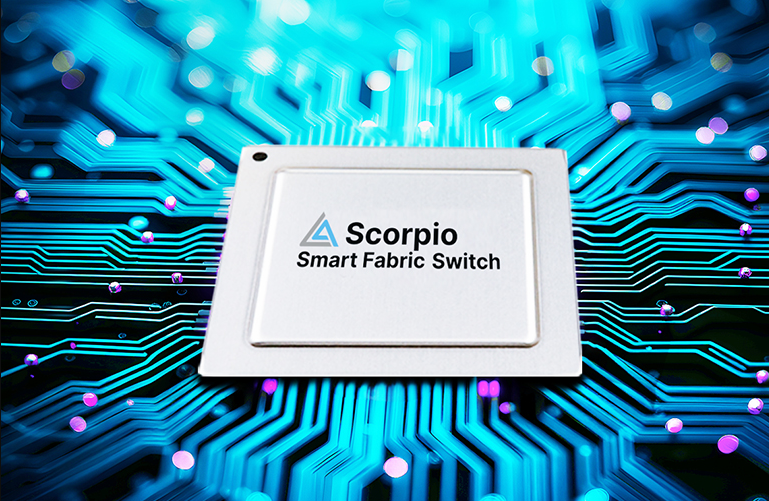
Astera Labs is targeting this inefficiency with the introduction of its Scorpio X-series, a fundamental departure from conventional networking. By adopting a memory-semantic architecture, Astera is moving away from the cumbersome packet-forwarding models that have historically defined inter-server communication.
This approach treats remote memory and storage as if they were physically soldered onto the local accelerator’s motherboard. By enabling CPUs and GPUs to utilize simple load/store operations across the fabric, the Scorpio X-series collapses the layers of network translation overhead that were previously necessary to negotiate between different memory domains. The result is a unified memory space that drastically improves the utilization of scattered data pools, essentially keeping GPUs fed much more consistently.
In-Network Intelligence: Reimagining Workload Distribution
Perhaps the most significant value proposition of the Scorpio X-series lies in its transition toward in-network processing. Through the integration of proprietary Hypercast and In-Network Compute (INC) technologies, the switch itself becomes an active participant in data throughput rather than a passive conduit.
By offloading complex collective operations—such as data synchronization and aggregation—directly onto the fabric, Astera is reducing the cognitive load on the GPUs. Instead of forcing the GPU to manage every individual packet interaction, the network fabric itself assists in organizing the data. This offloading strategy directly correlates to higher token velocity, which is the most critical metric for the commercial viability of generative AI platforms.
Physical Optimization: Redefining the Data Center Footprint
The density of current AI clusters has created a secondary crisis: thermal management and signal degradation caused by a literal forest of copper and fiber cabling. The Scorpio X-series addresses this through high-radix architecture, providing 320 lanes of PCIe 6 connectivity.
This level of density allows consolidation; a single Scorpio X-series chip can replace a complex array of legacy switches. By reducing the total number of hardware devices, data centers can shorten the physical distance packets need to travel, thereby improving signal integrity. This reduction in physical infrastructure not only simplifies data center maintenance but also significantly lowers the power consumption and cooling requirements—an increasingly urgent necessity as power-hungry clusters grow in size.
The Shift Toward Open Ecosystems
Technological innovation in this space is meaningless if it creates proprietary silos. Recognizing this, Astera Labs is positioning the X-series to integrate seamlessly with open industry standards, including UALink and NVLink Fusion.
By ensuring compatibility across a wide range of hardware accelerators, Astera is betting on a heterogeneous future where hyperscalers will likely mix and match different compute modules based on cost and performance needs. As infrastructure evolution struggles to keep pace with AI model development, the network fabric is becoming the single most critical investment layer. For the developers of the next generation of generative models, the competitive advantage will no longer depend solely on the raw power of the GPUs, but on the sophistication of the fabric that binds them together.