
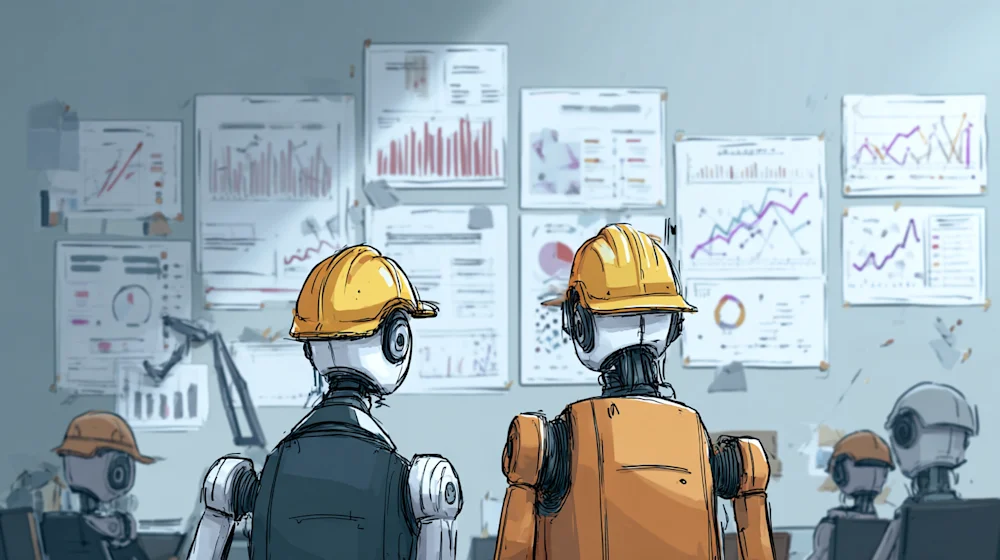
The Paradigm Shift: From Deterministic Code to Stochastic Reliability
Traditional software engineering relies on the binary comfort of determinism. In a standard stack, Input A processed by Function B results in a predictable Output C. This consistency allows developers to maintain robust CI/CD pipelines through unit tests that rarely fluctuate. However, the rise of generative AI has disrupted this foundation. Large Language Models (LLMs) are inherently stochastic; they do not simply run code—they generate probabilistic sequences.
For enterprise-grade applications, relying on anecdotally checking if a prompt feels right is a liability. In sectors such as fintech, healthcare, and law, AI hallucinations are not merely software bugs—they are critical compliance failures. To move toward production-readiness, engineering teams must transition from ad-hoc testing to a formal AI Evaluation Stack, treating model quality as a critical piece of infrastructure rather than an afterthought.
Defining the AI Evaluation Taxonomy
Evaluation in an AI-native context requires a bifurcated architecture that separates structural integrity from semantic intent.
Layer 1: Deterministic Assertions (The Fail-Fast Gate)
Most production issues are not nuanced semantic errors; they are structural failures. Before an LLM acts on a prompt, the system must validate the mechanical output. If a model is expected to provide structured JSON for an API tool call, the evaluation must use regex or schema validation to ensure the JSON is not malformed. This layer acts as a cost-effective, high-speed filter. If the structural integrity fails, the pipeline should short-circuit—preventing the query from ever reaching more expensive, compute-heavy diagnostic layers.
Layer 2: Model-Based Assertions (LLM-as-a-Judge)
When dealing with subjective quality—such as tone, politeness, or adherence to complex corporate policies—traditional code is insufficient. Here, the industry is increasingly adopting the LLM-as-a-Judge framework. This involves deploying a secondary, higher-reasoning model to assess the primary agent’s output. While using one LLM to evaluate another may seem circular, it provides a scalable proxy for human scrutiny. To be effective, these judges must be insulated from noise by three pillars:
- Frontier Model Selection: The judge must possess superior reasoning capabilities compared to the production model being tested.
- Rubric-Driven Scoring: Vague requests (e.g., rate this as good) produce incoherent data. Rubrics must explicitly define what constitutes a failure vs. a success across a defined gradient.
- Golden Dataset Alignment: The judge must evaluate production output against ground truth datasets—human-vetted responses that serve as the gold standard for expected behavior.
Architecting the Dual-Pipeline System
To achieve enterprise reliability, organizations must bridge the gap between development and production through two complementary pipelines.
The Offline Pipeline: Regression and Gating
The offline pipeline is your primary defense against drift and instability. It must be integrated as a blocking step in the CI/CD lifecycle. By curating a Golden Dataset—a version-controlled repository of 200–500 test cases—teams can stress-test the model against both happy-path scenarios and adversarial edge cases. Because generative models are interconnected, an update to fix a specific refusal bug can inadvertently break functional tool calls elsewhere. Regression testing against the entire golden dataset is mandatory after any change to system prompts or hyperparameters.
The Online Pipeline: Production Telemetry
The online pipeline functions as a continuous monitoring loop. Because user behavior evolves, a model that performs well during training can experience concept drift in production. Architects should instrument five key telemetry signals:
- Explicit Feedback: Utilizing user-driven interaction logs (thumbs up/down).
- Implicit Behavioral Cues: Monitoring retry rates, apology triggers in responses, and sudden spikes in refusal messages.
- Synchronous Deterministic Monitoring: Running Layer 1 (structural) checks on live production traffic.
- Asynchronous LLM-Judges: Sampling a fraction of live traffic (e.g., 5%) to grade semantic performance against the baseline rubric.
The Feedback Flywheel: Engineering Continuous Drift Correction
Evaluation is a dynamic process, not a static checkpoint. Data rot is inevitable; as enterprise products evolve, users will inevitably feed the system novel requests that fall outside the current test coverage.
The most mature engineering organizations build a closed-loop flywheel. When production telemetry identifies a success gap (e.g., a surge in user frustration regarding a new corporate policy), that failure is routed through a triage desk of domain experts. These human-in-the-loop (HITL) corrections are not only used to resolve immediate customer issues but are synthesized into the Golden Dataset. This ensures the offline pipeline grows in complexity alongside the product, preventing the drift that often leads to silent, degraded performance.
In this new era, done is no longer defined by code compilation. A feature is only complete when it is anchored in an automated evaluation stack that holds the model accountable to both the rigid constraints of code and the fluid expectations of the end user. Stop relying on subjective vibes, and build a deterministic framework that quantifies your model’s reliability.