
The Shift Toward Recursive AI Engineering
The evolution of artificial intelligence has hit a significant inflection point. For years, the development cycle—comprising hypothesis, experimentation, and analysis—has been tethered to human intervention. Even as AI tools have revolutionized specific domains like biology and code generation, the underlying AI stack (the architecture, data pipelines, and learning algorithms) remains largely crafted by human engineers. This is a manual, bottlenecked process that limits the pace of discovery.
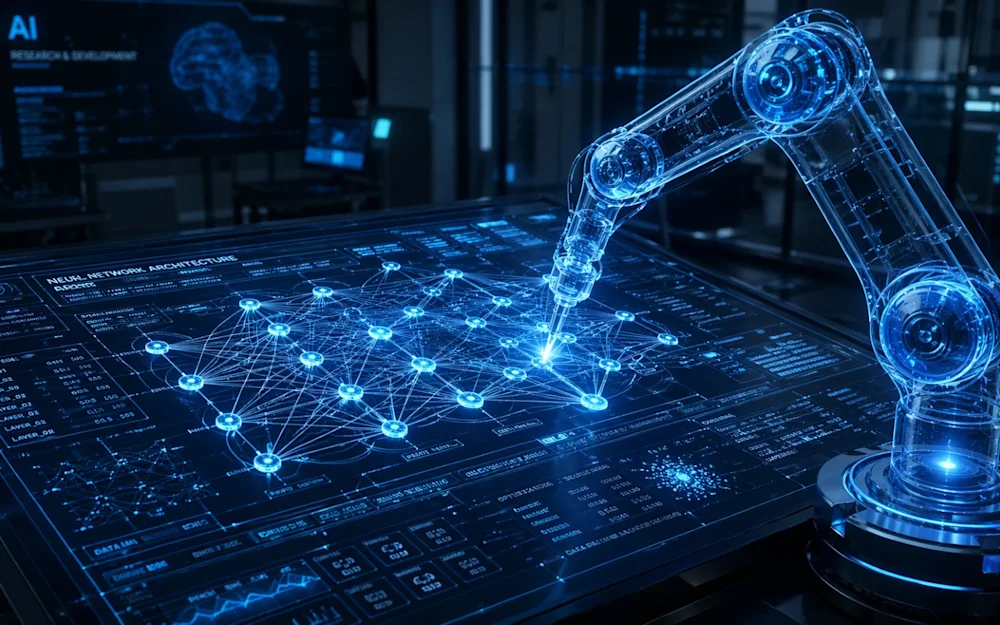
The emergence of the ASI-EVOLVE framework, developed by the Generative Artificial Intelligence Research Lab (SII-GAIR), signals a transition from AI as a tool to AI as an automated researcher. By moving toward a continuous learn-design-experiment-analyze loop, this agentic system aims to solve one of the most pressing challenges in the field: the scaling of systemic AI innovation.
Deconstructing the Bottleneck of Manual R&D
Modern AI development is constrained by the knowledge silo effect. When engineering teams test new model architectures or data cleaning strategies, the results are often ephemeral—captured in institutional memory but rarely synthesized into reusable, systemic insights.
Furthermore, the design space for base models is essentially infinite. Human engineers can only explore an infinitesimal fraction of possible architectural or algorithmic permutations. As research necessitates massive, compute-intensive trials, the cost of error—or even the cost of a neutral result—becomes prohibitive. Without a mechanism to systematically convert experimental failure and success into a cumulative foundation, innovation remains linear when it needs to be exponential.
Inside the ASI-EVOLVE Loop
Unlike existing auto-ML solutions that focus on narrow tasks, ASI-EVOLVE treats the research process itself as the subject for optimization. The framework relies on four pillars that move beyond mere trial-and-error:
- The Cognition Base: This serves as the system’s long-term memory, pre-loaded with theoretical heuristics, historical research, and identified pitfalls. By grounding the agent in existing domain expertise, the framework bypasses redundant experimentation.
- The Researcher and Engineer: The researcher agent synthesizes historical data to form hypotheses, while the engineer agent executes them. Crucially, the engineer includes automated gating mechanisms to reject underperforming trials early, preserving valuable GPU resources.
- The Analyzer: This is arguably the most critical component. It transforms high-dimensional, raw telemetry—such as training logs and benchmark drifts—into concise, human-readable causal analyses that get fed back into the Cognition Base.
- The Database of Record: By formalizing the research journey as a structured database of successes and failures, ASI-EVOLVE creates an institutional library of research outcomes that evolves as the system runs.
Implications for Enterprise AI Scalability
The performance benchmarks achieved by ASI-EVOLVE are startling. By autonomously redesigning pretraining data pipelines, the framework achieved an 18-point boost in MMLU scores. Perhaps more impressively, it generated 105 unique, high-performance attention architectures and pioneered new reinforcement learning optimization techniques that outperformed human-designed standards like GRPO.
For the enterprise sector, these results represent a potential paradigm shift in resource allocation. Currently, smaller teams find themselves boxed out of high-end model optimization due to the sheer cost of engineering man-hours. ASI-EVOLVE offers a path to democratize this capability: by feeding proprietary domain knowledge into the Cognition Base, organizations could theoretically automate the fine-tuning of models against their internal data without needing a massive R&D team to handle every iteration.
The Horizon of Automated Innovation
While the framework is currently an open-source research initiative, its existence challenges the static nature of AI development workflows. If AI can successfully manage its own learning path—improving its architecture, data diet, and training logic iteratively—the role of the AI engineer will undergo a fundamental transition.
Instead of manual implementation and parameter tuning, the engineer’s role becomes that of an orchestrator of research objectives. As ASI-EVOLVE continues to demonstrate that it can evolve its own cognition, the field moves closer to a future where AI systems possess the autonomous capacity to reach their own theoretical peak, rather than being limited by the speed of human analysis.