
The Obsolescence of Title-Based Expertise Discovery
The professional expert network landscape has long been tethered to the CV paradigm, a legacy framework dominated by players like GLG and AlphaSights. This model treats a consultant’s value as a product of their prior employers and formal job titles. However, for private equity firms and hedge funds, this reliance on static metadata has created a systemic expertise mismatch.
Resumes are inherently retrospective and performative documents; they rarely capture the granular, tacit knowledge required to solve high-stakes operational problems. By prioritizing pedigree over practical, niche-specific experience, traditional networks often filter out the very individuals who possess the highly specialized insights institutional investors demand. Ethos is positioning itself to disrupt this inertia, signaling a shift where traditional recruitment methodologies are replaced by dynamic, intent-driven knowledge mapping.
From Boolean Keywords to Semantic Intent
The core inefficiency of incumbent platforms is their restrictive onboarding architecture. Standard registration forms quantify a person through binary fields—years of experience, industry, and previous employers. This fails to surface talent whose expertise is buried in niche open-source development, academic research, or obscure technical contributions.
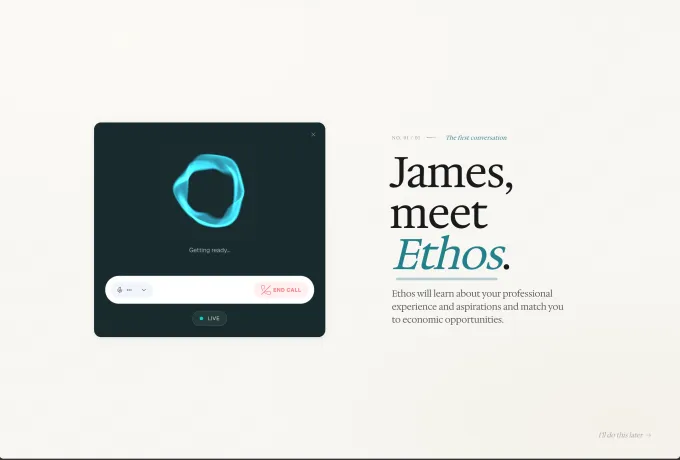
Ethos addresses this by replacing static forms with voice-powered AI interviews. By engaging experts in natural language dialogue, the platform parses depth of knowledge rather than just mapping job history. This transforms the client’s search experience. Instead of executing limited Boolean queries for a Director of Logistics, users can now perform semantic searches for individuals who have successfully navigated supply chain restructuring during geopolitical disruptions in Southeast Asia. This shift from title-matching to intent-mapping allows clients to drill down into the how rather than the where, effectively surfacing hidden talent that remains invisible to search engines focused solely on professional bio snapshots.
Institutional Backing and the Knowledge Graph
The recent $22.75 million Series A round, spearheaded by Andreessen Horowitz alongside General Catalyst and XTX Markets, validates the industry’s growing appetite for high-fidelity human signal. The investment is underpinned by the belief that existing networks have become structurally vulnerable due to their reliance on surface-level data.
Under the leadership of James Lo and DeepMind alumnus Daniel Mankowitz, Ethos is constructing a comprehensive knowledge graph. By synthesizing public-web activity—such as peer-reviewed journals and technical thought leadership—with proprietary signals harvested from interactive AI interviews, the company is building a verifiable map of the global innovation economy. This is not merely a database; it is a high-resolution infrastructure that tracks how a specific professional’s expertise maps against real-world, localized complexity.
The Ground Truth Infrastructure for Agentic AI
Ethos’s long-term utility extends far beyond the traditional expert network use case. As the tech sector pivots toward the agent economy, there is an unprecedented demand for verified, high-quality human data to train, fine-tune, and ground large-scale AI models.
General-purpose models often falter in specialized domains like clinical diagnostics or quantitative finance; they require the human ground truth that only leading practitioners can provide. By positioning itself as the primary pipeline for this specialized human input, Ethos is evolving into an infrastructure player. The startup is effectively becoming an essential human-in-the-loop conduit for AI development, providing the institutional knowledge necessary to prevent agentic systems from drifting into hallucinated, theoretical outputs.
Operational Moats: Scaling Quality in a Hyper-Competitive Market
While Ethos claims impressive growth metrics—including a weekly intake of 35,000 experts and rapid revenue scaling—its true challenge lies in operational rigor. Maintaining the semantic integrity of a knowledge graph while scaling across diverse global sectors is a monumental task. The company faces increasing competition from agile, tech-forward rivals like Listen Labs and Outset, both of which are also leveraging conversational AI to disrupt the status quo.
The future of Ethos will be defined by its quality moat. If the platform can reliably extract and index institutional-grade intelligence that rivals cannot surface through standard database queries, it will force a fundamental market pivot. The industry is nearing a tipping point where speed alone is insufficient. The winner of this transition will not be the company with the largest directory, but the one that best identifies the hidden expert—the individual whose unique, nuanced experience provides a competitive edge that no resume-based search could ever uncover.