
The Context Engineering Crisis
As generative AI transitions from broad conversational tools to specialized enterprise agents, a structural bottleneck has emerged. While Large Language Models (LLMs) are increasingly capable of executing complex workflows in finance, legal, and software engineering, they remain fundamentally amnesiac regarding the tribal knowledge that defines a business. These agents lack access to the nuance of ongoing stakeholder discussions, the evolving intent behind project roadmaps, and the implicit constraints of human teamwork.
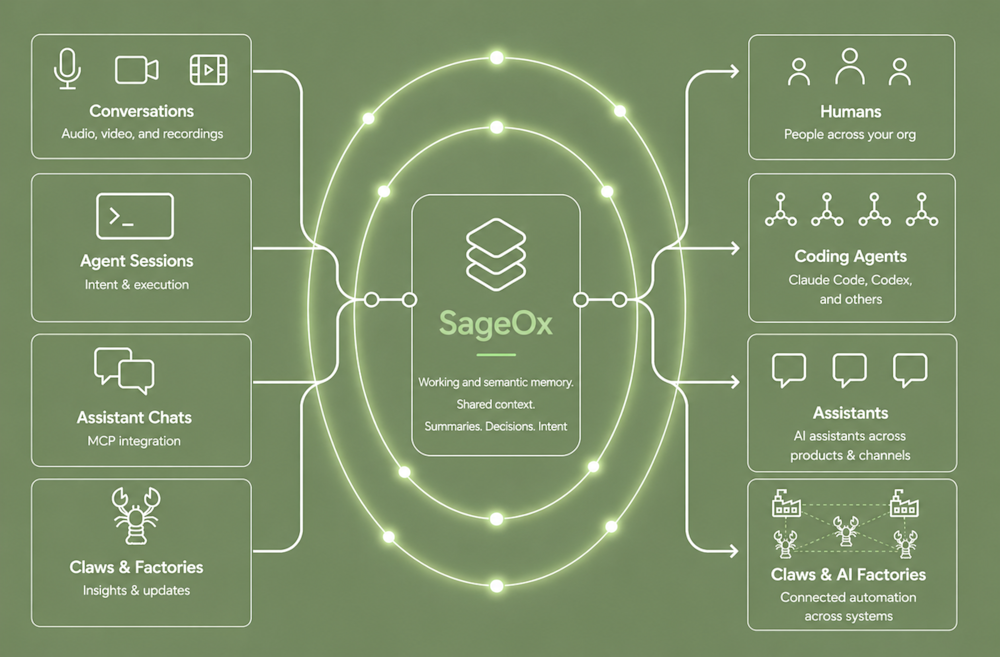
In the industry, this is known as the context gap. Without a mechanism to bridge the divide between high-level executive intent and low-level code execution, AI agents are prone to drift—straying from the strategic objectives of the firm. Seattle-based startup SageOx, led by former AWS, Meta, and Hugging Face engineers, is attempting to solve this with a new category of infrastructure they dub agentic context infrastructure.
Bridging the Gap Between Intent and Execution
SageOx, which recently emerged from stealth with $15 million in seed funding, argues that traditional documentation systems like Jira or static wikis have failed to keep pace with the velocity of AI-first development. The company proposes a hivemind model that captures the why behind the what, allowing agents to operate with the same implicit awareness as a veteran human team member.
The strategy hinges on a multi-modal approach to context gathering:
Ox Dot: A physical recording hardware device for the office environment. It captures meetings and brainstorming sessions, featuring an Auto Rewind functionality that allows teams to retrospectively capture critical decisions made in spontaneous conversations.
Integrated Data Ingestion: The system pulls context from standard enterprise stack applications, including Slack, email, and document repositories, normalizing disparate streams into a unified data environment.
* Ox CLI: An open-source, MIT-licensed command-line interface that allows developers to prime LLMs. By using protocols like `ox agent prime`, agents can gain immediate access to the team’s historical intent and technical constraints before initiating a task, effectively eliminating the need for manual prompting on project history.
Reframing Software Management for AI Agents
The rise of agentic engineering requires more than just new tools; it necessitates a total overhaul of software management principles. SageOx is challenging the long-held industry standard of clean code and massive, monolithic Pull Requests (PRs).
Drawing from their experience at Amazon, the SageOx engineering team—including CTO Ryan Snodgrass—argues that large PRs are suboptimal for AI reasoning. They advocate for higher-frequency, granular commits that the AI can easily parse and correlate with project context. This agent-readable repository history fundamentally changes how human-machine teams track progress, effectively replacing traditional documentation with a live, machine-readable record of evolving project architecture.
The Shift to Radically Transparent Development
Perhaps the most disruptive aspect of the SageOx approach is its commitment to Open Work. Going beyond conventional open-source distribution, the company is practicing a model of radical transparency. By sharing internal prompts, unfiltered planning sessions, and real-time development streams publicly, the startup aims to set a new benchmark for how modern businesses accelerate AI adoption.
For the industry, this represents a pivot away from the siloed software model. By making the how of their operations transparent, SageOx is gambling that the future of enterprise value will not lie in protected proprietary processes, but in the efficiency of the context layer itself. As the company scales, it is banking on an adoption cycle modeled after AWS EC2’s growth: starting with lean, AI-native startups before penetrating the complexities of the legacy enterprise market.
Implications for the AI Infrastructure Landscape
The emergence of SageOx signifies a maturation point for the enterprise AI market. For the past two years, the focus has been on model performance—reducing hallucinations and improving reasoning capabilities. Now, the burden of proof is shifting toward systemic alignment.
If SageOx succeeds, the competitive advantage for firms will no longer be centered on code repositories or raw compute power, but on their ability to create a parallel processing environment1 where AI and humans share the same cognitive frame of reference. By treating team memory as a core infrastructure service, SageOx is positioning itself as the middleware of the agentic era, attempting to ensure that an organization—no matter its size—can act with the fluidity of a single, well-coordinated mind.