
The Pivot Toward Industrialized Fusion
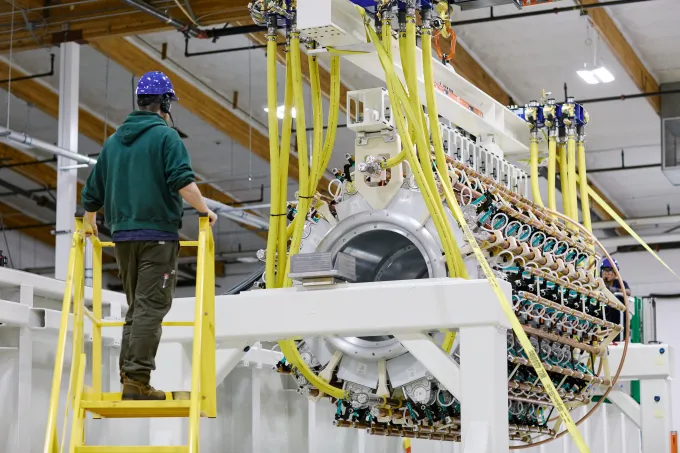
Pacific Fusion has entered a critical implementation phase with the unveiling of its latest pulser module prototype. By transitioning from theoretical design to architectural reality, the company is positioning itself to break ground on a demonstration power plant this summer. This move marks a departure from pure R&D, signaling that the company is confident enough in its hardware architecture to initiate capital-intensive site development.
The startup is adopting a strategic funding and development framework borrowed from the biotechnology sector. By utilizing a tranche-based growth model, Pacific Fusion aims to insulate its engineering team from the volatility of perpetual fundraising cycles. This methodology allows the firm to treat engineering milestones as distinct go/no-go gates, ensuring that capital is only deployed once specific technical thresholds are met. It is a pragmatic shift in an industry historically defined by decade-long timelines and opaque success metrics.
Deconstructing Inertial Confinement
While the National Ignition Facility (NIF) proved that inertial confinement fusion could achieve scientific breakeven using high-energy lasers, the approach remains notoriously difficult to scale for commercial electricity generation. Pacific Fusion is betting on a more modular architecture, swapping massive, costly laser arrays for 156 heavy-duty pulser modules.
The technical objective is to synchronize these modules to deliver a massive electrical jolt—compressed into a 100-nanosecond window—to an eraser-sized fuel target. This pulse must generate a magnetic field of sufficient intensity to induce compression and ignite a fusion reaction. The challenge here is less about the physics of fusion and more about the precision of power electronics. Achieving the necessary temporal accuracy across 156 distinct modules, each composed of multiple capacitor stages, presents a significant systems-engineering hurdle.
The Prototype Milestone
The recently tested prototype serves as a vital proof-of-concept. At roughly one-third the scale of the full system, the module successfully delivered 440 gigawatts of peak power in an 80-nanosecond burst. This success validates the startup’s core hypothesis: that it can orchestrate high-energy discharge through a repetitive, scalable, and modular framework. According to company leadership, this performance data satisfies the requirements needed to proceed with the primary, full-scale system.
However, the leap from a one-third-scale test unit to a 156-module integrated facility is significant. The synchronization of 32 circular stages per module, with each stage housing multiple capacitor-switch sets, requires unprecedented reliability in power switching. Any jitter or failure in a single capacitor brick could disrupt the implosion symmetry of the fuel pellet, rendering the reaction inert.
Aiming Beyond Scientific Breakeven
The industry standard for decades has been scientific breakeven—the point where the fusion reaction produces more energy than the laser or mechanism used to initiate it. Pacific Fusion is attempting to bypass this intermediate benchmark in favor of facility breakeven. This next-tier goal dictates that the entire power plant must output enough electricity to run its own auxiliary systems, cooling, and controls, while still providing a net surplus to the grid.
This is a bold ambition that changes the calculus for fusion startups. While competitors remain focused on perfecting the physics of the plasma, Pacific Fusion is already integrating the engineering requirements of a functional power station. If the company can demonstrate facility breakeven, it will move fusion from the realm of experimental physics into the domain of viable, decentralized infrastructure. Success would validate the premise that modularized, capacitor-driven power delivery is the fastest route to transitioning fusion from the laboratory to the commercial utility market.