
The Latency Tax of Generative AI
The current architecture of generative AI is inherently inefficient. Every time a user submits a prompt to an LLM, a high-stakes data relay race ensues. The request is shuttled from the system’s memory to a CPU for preprocessing, sent to a power-hungry GPU for heavy mathematical computation, and then mirrored back. This cycle repeats for every individual token generated. This creates a structural bottleneck where precious, expensive compute cycles are wasted on moving data rather than processing it.
The industry has largely accepted this latency tax as the price of admission for modern intelligence. However, the overhead of constant data migration between processors and memory modules is becoming the primary limitation on how quickly AI can scale.
Near-Memory Computing: A Structural Pivot
XCENA, a four-year-old startup operating out of South Korea and the United States, is challenging this status quo. By shifting the paradigm from compute-centric to memory-centric, they are aiming to eradicate the necessity of the classic processor-memory round trip.
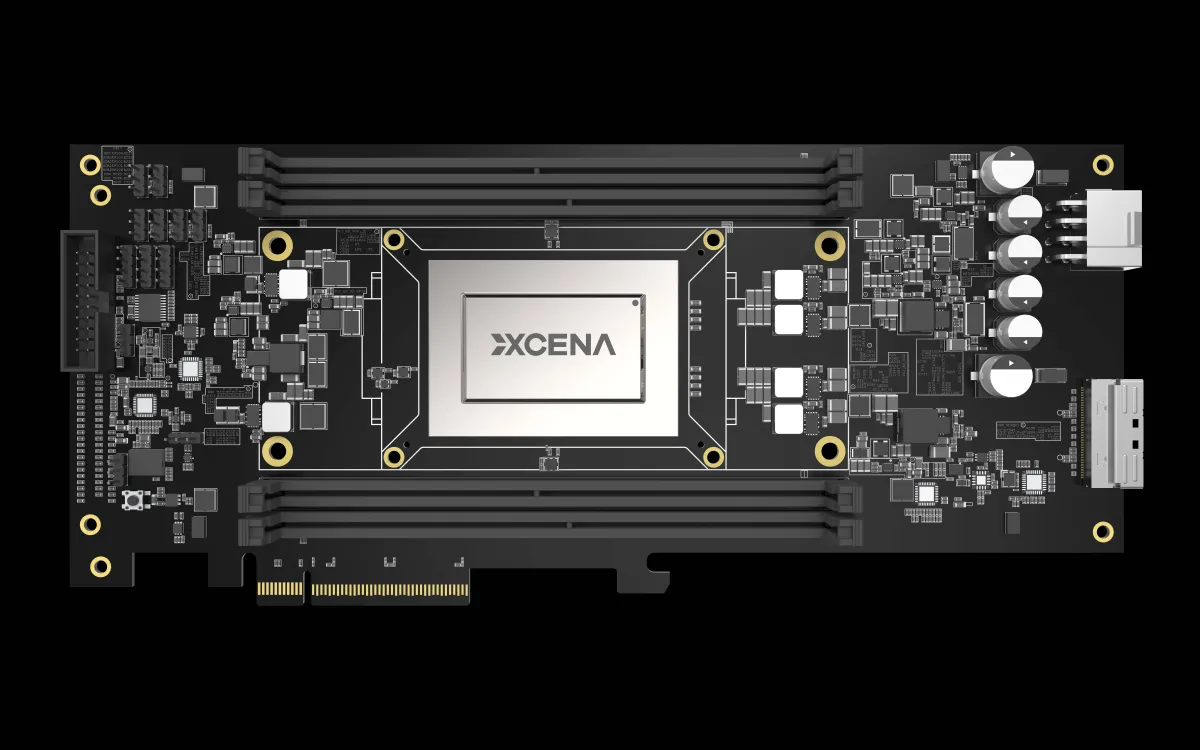
Their flagship solution, the MX1, implements the compute-to-data thesis. Instead of forcing data to traverse the motherboard to reach a CPU, the MX1 integrates computational capabilities directly into the DRAM—the high-speed, short-term memory where active data resides. By utilizing the Compute Express Link (CXL)—a high-bandwidth interface designed for low-latency communication—XCENA positions its chip as a dedicated accelerator for the overhead tasks that currently clog up system resources.
Reclaiming Specialized Workloads
While GPUs remain the gold standard for matrix multiplication and intensive model training, they are inefficient for the granular work of AI orchestration. Tasks such as KV cache management—which sustains conversational context—and routine data preprocessing currently drain CPU power and congest data buses.
XCENA’s architecture offloads these auxiliary tasks into the memory module. According to the company, this consolidation is transformative; they claim that workloads currently requiring 10 servers could, in theory, be handled by a single unit. This level of density could slash capital expenditure for hyperscalers, who are effectively bleeding money on redundant data movement.
Hardware Integration and the Competitive Landscape
XCENA’s $135 million Series B round, which brings their total funding to $185 million at a $570 million valuation, signals significant market confidence. Unlike competitors like Marvell or Astera Labs, which often rely on broader, general-purpose core architectures, XCENA is banking on deep vertical integration.
Their design uses a massive array of thousands of RISC-V cores. By keeping these cores compact and specialized, and by retaining full control over their internal memory hierarchy, interconnect bus, and DRAM controller, XCENA is bypassing the traditional reliance on third-party IP blocks.
The Road to 2027
The current push for memory-centric solutions is perfectly timed. Global hyperscalers are desperate to optimize the TCO (total cost of ownership) of their massive AI deployments. Even minor improvements in memory efficiency translate to millions of dollars in saved electricity and hardware costs annually.
However, the hardware cycle remains grueling. While the MX1 is currently at the prototype stage, the definitive test will come when these chips enter mass production at Samsung’s foundries in late 2026. If XCENA delivers on its promise to begin revenue generation by 2027, it could fundamentally disrupt the memory infrastructure layer and force a reassessment of what constitutes an AI server. By addressing the memory-scaling problem, XCENA is moving to control the foundational layer upon which the next generation of AI inference will be built.