
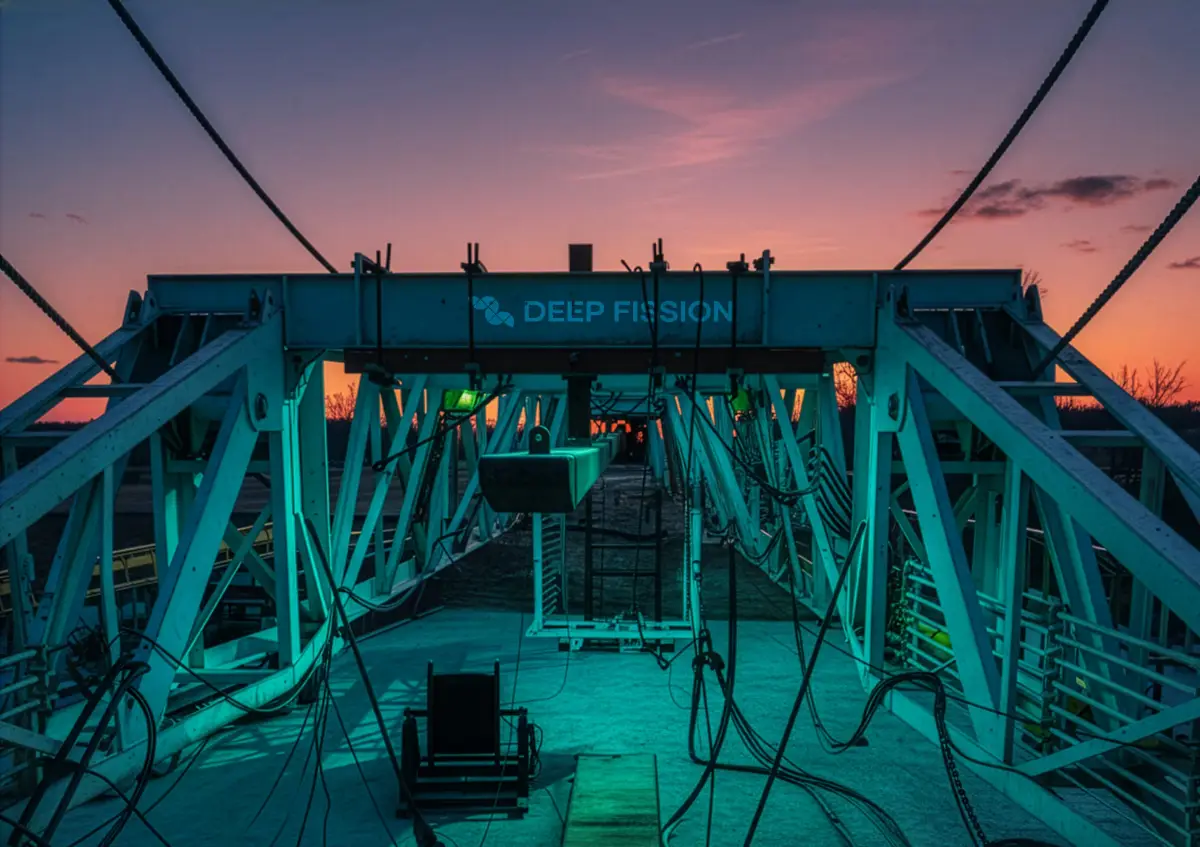
The Illusion of Nuclear Progress: Deep Fission’s Nasdaq Pivot
Nuclear startup Deep Fission is attempting a multi-hundred-million-dollar Nasdaq IPO, a move that feels remarkably familiar—largely because the company attempted a public transition just last year. In September 2023, Deep Fission announced a reverse merger with Surfside Acquisition, a shell entity that ostensibly granted it public reporting status. Yet, the anticipated liquidity and market presence never materialized. The stock remained untraded, and the company failed to gain traction on secondary markets like the OTCQB.
This latest maneuver toward a traditional Nasdaq listing, aiming for a valuation reaching $1.66 billion, highlights a troubling trend: the decoupling of speculative market valuation from tangible engineering progress. While the company pursues a nine-figure capital infusion, its internal disclosures paint a picture of operational stagnation.
Financial Turbulence and the Going Concern Warning
Despite the ambitious valuation, Deep Fission’s financial foundations are increasingly fragile. The company remains tethered to a going concern warning, clearly indicating that survival is predicated on the success of this IPO. Financial filings reveal an accelerating deficit, which ballooned from $56.2 million in December to $88.1 million by March.
Over the course of just six weeks in early 2024, the company burned through roughly 7% of its remaining cash reserves. These figures suggest that without a successful market exit, the startup’s runway is perilously short. The paradox here is striking: a company struggling to maintain its basic solvency is simultaneously positioning itself for a massive public offering based on the promise of future subterranean reactor deployments.
The Engineering Bottleneck: Scale and Reality
Deep Fission’s technological roadmap has faced significant setbacks. The timeline for achieving nuclear criticality has been scrubbed from public estimates, following an earlier, abandoned goal of July 2026. The shift in organizational focus—now emphasizing the drilling of small-diameter test wells—serves as a tacit admission that its core engineering premise remains unproven.
The transition from a 6,000-foot-deep, eight-inch-wide test hole to a commercial-scale reactor housing is not merely a scaling issue; it is a fundamental engineering hurdle. To house a viable reactor, the company anticipates needing boreholes up to 50 inches in diameter. Such dimensions exceed standard deep-drilling capabilities currently utilized in the oil and gas sector. Until Deep Fission can confirm the feasibility of these structural requirements, its reactor design remains in, at best, a conceptual state.
Industry Implications: The AI-Nuclear Hype Cycle
The desire to pair modular nuclear power with high-density AI data centers is driving a gold-rush mentality. Deep Fission’s strategy mirrors broader industry patterns where firms attempt to capture investor capital by hitching their wagons to the surging energy demands of hyperscalers.
However, the contrast between Deep Fission and competitors like X-energy is telling. While X-energy is navigating the complexities of the Nuclear Regulatory Commission (NRC) with actual revenue streams, Deep Fission’s valuation seems to rely entirely on investor sentiment rather than regulatory or commercial milestones.
For the broader tech and energy sectors, Deep Fission represents a cautionary tale. While the appetite for carbon-free, localized power is genuine, the gap between capital market expectations and the harsh realities of nuclear engineering and licensing remains immense. Investors are effectively betting on the potential of a concept that hasn’t yet cleared the most basic geological or technical feasibility tests, illustrating the danger of market enthusiasm outpacing hardware development.