
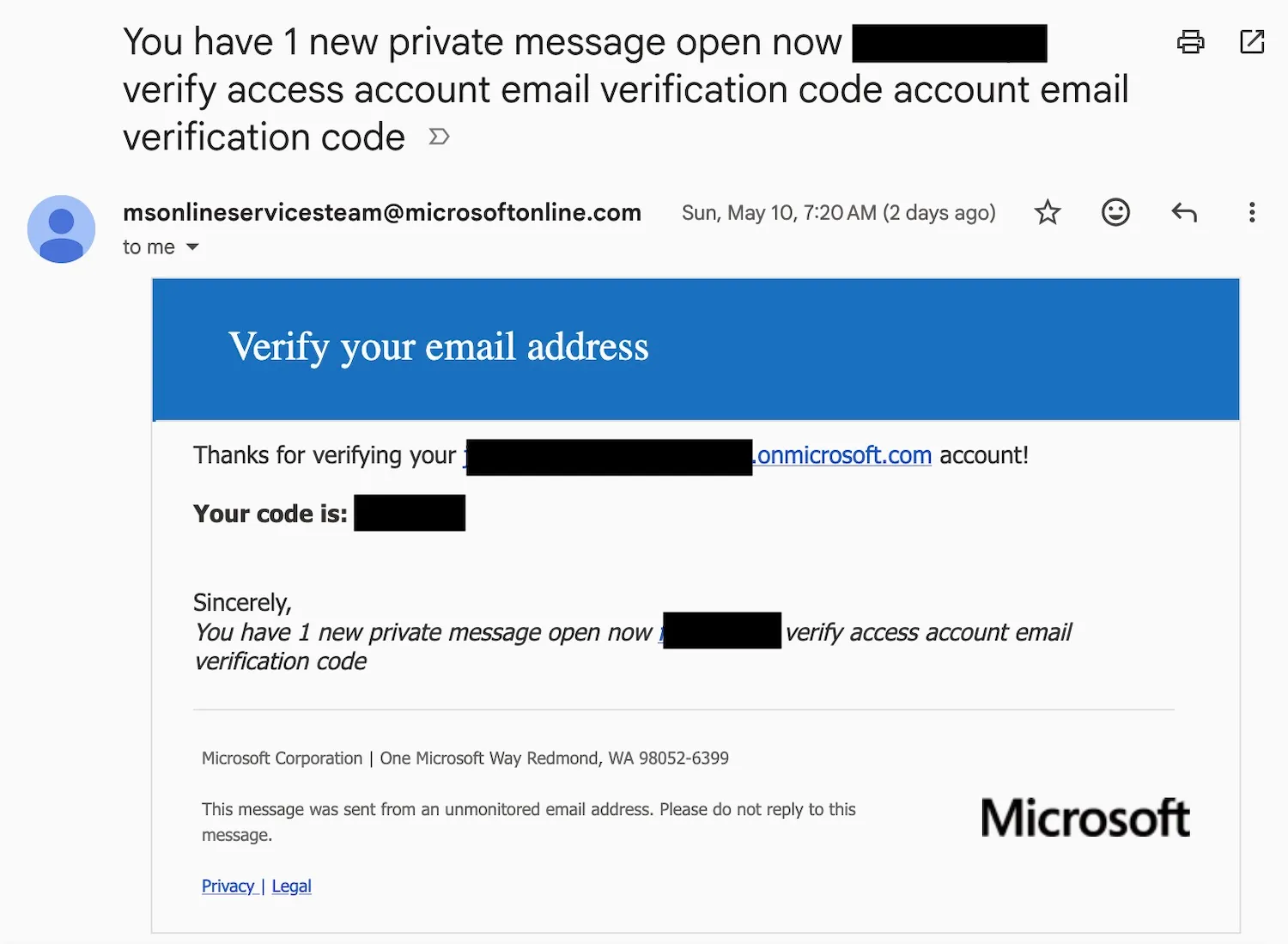
The Anatomy of a Trusted Sender Exploitation
A critical security vulnerability within Microsoft’s notification infrastructure has enabled scammers to bypass standard spam filters by masquerading as official service communications. By leveraging the domain [email protected]—an address typically reserved for legitimate security alerts such as two-factor authentication (2FA) and account recovery codes—malicious actors are successfully delivering phishing links directly to primary inboxes.
Industry analysis suggests that the attackers are manipulating Microsoft’s automated account creation flows to repurpose trusted outbound mail relay systems. Instead of spoofing a domain, which would be flagged immediately by DMARC or SPF protocols, these bad actors are operating from within the legitimate Microsoft ecosystem. This effectively weaponizes the reputation of the sender domain, forcing security gateways to categorize these malicious messages as trusted traffic.
The Implications for Corporate Credibility
The Spamhaus Project, a prominent anti-spam organization, has confirmed that this exploit has been active for several months. Their assessment highlights a fundamental flaw in enterprise-grade notification systems: over-automation. When a system allows for high levels of customization within automated outbound emails, it provides a playground for social engineering.
The implications for the industry are profound. As users are conditioned to trust alerts from names like Microsoft Online Service Team, the breakdown of this trust represents a significant erosion of security hygiene. If users cannot rely on the authenticity of an account alert from a cloud provider, the entire mechanism of account security—which relies on user vigilance—is compromised.
A Growing Trend in Platform Hijacking
This incident is not an isolated case but part of a disturbing trend of platform hijacking, where attackers exploit the internal notification pipes of major service providers. Earlier this year, fintech firm Betterment suffered a similar breach, where attackers utilized their internal systems to push fraudulent cryptocurrency schemes. Similarly, Namecheap experienced an incident where unauthorized access to their email infrastructure resulted in automated credential-harvesting campaigns.
The shift toward abusing internal infrastructure points to a new strategy among threat actors: rather than attempting to penetrate client-side defenses, they are compromising the source of truth. These attacks demonstrate that even the most rigorous sender authentication protocols are insufficient if the sender’s own internal logic can be subverted to host malicious content.
The Urgent Need for Infrastructure Audits
The failure of Microsoft to swiftly neutralize this threat illustrates the complexities involved in securing massive, distributed cloud architectures. As these systems scale, the granular control over outbound messaging templates often becomes fragmented, creating shadow pathways for abuse.
For the cybersecurity community, this development underscores the necessity for more refined reputation-scoring algorithms. Rather than relying solely on the sender domain, platforms must implement behavioral analysis on the content of triggered emails. If a notification system is suddenly being used to transmit atypical links or suspicious calls to action, automated safety measures must trigger a global hold on that specific account’s permissions. Without a fundamental redesign of how official notification addresses authorize content, the industry remains vulnerable to a cycle where the very tools meant to protect users become the primary vehicles for their exploitation.