
The Shift from Passive BI to Agentic Autonomy
The business intelligence (BI) landscape is undergoing a fundamental transformation. For decades, BI platforms functioned as digital rear-view mirrors—aggregating data to provide reports that informed human decision-making. WisdomAI Inc. is looking to upend this model by evolving its federated intelligence platform into an agentic-first ecosystem. By moving beyond static visualization and text-based chatbots, the company is bridging the long-standing divide between data insight and operational execution.
This is not merely an incremental update; it represents a strategic push toward autonomous analytics. By integrating agentic workflows that can take action upon user authorization, WisdomAI is positioning its tool as a core engine for enterprise automation rather than just a reporting interface.
Architectural Foundation: Context Is Key
The success of agentic AI in a corporate environment hinges on the reliability of the underlying data infrastructure. WisdomAI’s approach centers on its Enterprise Context Layer, a sophisticated engine that reconciles disparate data sources—ranging from structured tables to unstructured PDFs and knowledge bases—into a unified, usable format.
The platform utilizes the Model Context Protocol (MCP) to enable its agents to traverse distributed data systems in real-time. By leveraging organization-specific data dictionaries, the system ensures that the agents understand the semantic meaning behind records, such as department hierarchies and specific business terminologies. This context-aware framework is critical; it mitigates common failures in autonomous work, such as misinterpreting data labels or ignoring idiosyncratic business logic.
Governance, Auditability, and the Human-in-the-Loop Model
One of the primary concerns hindering the adoption of agentic AI in the enterprise is the “black box” problem—the tendency of AI models to make non-transparent decisions. WisdomAI addresses this through its Adaptive Context Engine, which prioritizes deterministic outcomes.
Every action taken by these agents is fully auditable. Because the platform preserves the lineage of every workflow—including schemas and logic chains—administrators can replay past decision-making processes. This granular audit trail is essential for compliance and debugging, allowing engineers to identify exactly where a logic error or data mismatch occurred.
Furthermore, the platform incorporates self-correction mechanisms. If an agent detects an inconsistency in its reasoning or a discrepancy in data quality, it is designed to attempt a fix or, failing that, escalate the issue to a human supervisor. This keeps the “human-in-the-loop” paradigm intact while reducing the manual overhead typically required for lower-level data analysis.
Closing the Execution Gap
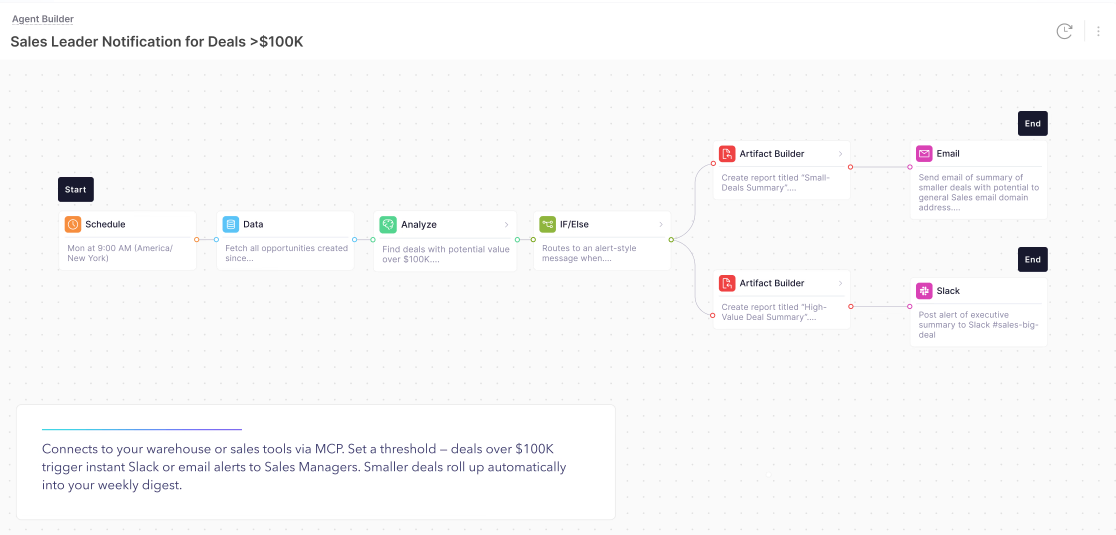
The practical application of these agents is managed via a low-code prompt-to-workflow interface. Users describe a desired outcome in natural language, and the WisdomAI Agent Builder automates the construction of the underlying logic nodes. This approach democratizes the creation of complex automations, moving the burden of coding away from the end-user.
Early adopters, including firms in the financial technology and high-velocity real estate sectors, have already utilized these capabilities to deliver real-time, proactive client intelligence. By automating the data exploration process, these organizations are shifting their human capital away from repetitive aggregation tasks toward higher-value strategic engagement.
As the industry moves toward agentic models, the differentiator will not be the raw power of the underlying AI, but the ability to maintain rigorous organizational governance. WisdomAI’s integration of deterministic auditing and context-driven workflows sets a high bar for enterprise-grade agentic platforms. The transition from “telling the user” to “doing the work” signifies a new maturity in AI adoption, one where software ceases to be a tool for observation and becomes an active participant in business delivery.