
The Shift from Deployment to Performance: Why Agentic AI Needs Product Analytics
The artificial intelligence landscape is undergoing a critical transition. While the past eighteen months were defined by the race to deploy Large Language Models (LLMs), the current phase is focused on the viability of agentic systems. Voker, a startup specializing in agent analytics, has signaled this industry pivot by securing $2.2 million in pre-seed funding from Y Combinator and FundersClub.
For many enterprise teams, the initial hurdle of building an AI agent has been cleared thanks to pretrained models. However, the move to production exposes a value gap that existing observability tools are failing to bridge. As AI agents increasingly inhabit customer-facing roles, businesses are struggling to reconcile high-level marketing promises with the reality of day-to-day performance.
Exposing the Ask Me Anything Dilemma
The common failure mode for modern AI agents is the ask me anything problem. Because LLMs are inherently broad, users often expect them to function as omniscient assistants. When a hotel booking agent is deployed, users frequently attempt to use it for peripheral tasks, such as solving math homework or providing unsolicited advice, falling well outside the agent’s intended scope.
Voker CEO Tyler Postle notes that this creates a dangerous disconnect. When agents fail to meet the inflated expectations set by marketing, users lose trust and revert to traditional, manual workflows. This trajectory suggests that if product teams cannot quantify—and subsequently improve—the tangible business value of these agents, high churn rates will become a recurring theme in the AI sector.
Bridging the Visibility Gap for Cross-Functional Teams
A core issue identified by Voker is that current AI observability stacks are fundamentally engineered for the wrong audience. Existing tools often focus on trace debugging—perfect for a developer trying to identify why an API call failed or why a token count spiked. However, these tools are largely inaccessible to the product managers, designers, and executives who need to understand how an agent is performing in the wild.
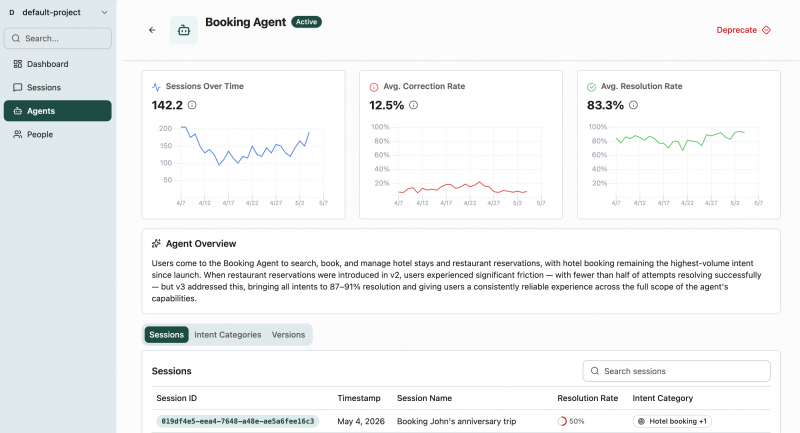
When an AI agent handles millions of monthly conversations, manual log analysis is not just inefficient; it is statistically and operationally impossible. Voker aims to fill this void by providing proactive insights. Instead of focusing only on system health, Voker’s platform identifies new user intents.
If a hotel bot consistently receives queries about local restaurant menus, the platform highlights this to the product team. This allows designers to iteratively evolve the bot’s capabilities, turning operational data into a roadmap for product development. This functionality shifts measurement from technical uptime to metrics like customer satisfaction, intent fulfillment, and ROI.
Abandoning the Raw Logs Fallacy
As Voker enters the market, it faces competition from engineers who lean on DIY solutions. A common practice involves feeding massive quantities of raw logs into LLMs like ChatGPT to perform ad-hoc analysis. While this provides a rapid snapshot, Postle argues it is fundamentally unscalable and prone to error.
Sticking hundreds of thousands of lines of log data into a context window leads to a lack of statistical rigour and overlooks systemic trends. For enterprise-grade product management, guesswork via chatbot is a temporary fix, not a strategy.
The Future of Agent Productization
Voker’s target market centers on teams currently managing at least 1,000 conversations per month. At this scale, the necessity for structured, actionable data becomes an existential requirement for the product. By democratizing AI performance data—making it readable for non-engineers—Voker is positioning itself not as a debugging tool, but as a mandatory component of the Agent Lifecycle Management (ALM) toolkit.
As enterprises move beyond the experimental phase of AI, winning companies will be those that can objectively measure their agents’ impact on customer behavior and rapidly adapt their systems to meet evolving real-world demands. Voker’s recent funding highlights that investors are shifting their focus toward the plumbing of AI—the infrastructure that makes these models sustainable products rather than just technical demos.