
The Infrastructure Arbitrage: Decart.ai’s $300M Funding Signals a Shift Toward Model Agnostic Architecture
Decart.ai Inc. has secured $300 million in a funding round that pushes its valuation to nearly $4 billion. Led by Radical Ventures with strategic participation from Nvidia, Adobe, and Toyota, this capital injection underscores a growing industry realization: software, not just hardware, is the new bottleneck in the AI supply chain. With backing from influential figures like Andrej Karpathy, Decart is positioning itself to solve one of the most expensive headaches in modern computing: hardware fragmentation.
Solving the Hardware Bottleneck: The DOS Advantage
The current AI landscape is characterized by forced vendor lock-in. When a laboratory develops a model, it must painstakingly re-optimize weights and kernels to ensure performance across different architectures—a transition that often consumes months of engineering labor. Decart’s flagship platform, DOS, aims to collapse this timeline into mere weeks.
By acting as a universal translation and optimization layer, DOS allows developers to move workloads across diverse hardware configurations without starting the optimization process from scratch. As cloud providers and enterprise labs contend with persistent GPU shortages, the ability to shift compute from one chip architecture to another without significant performance degradation is a massive economic lever. Decart reports that it is already generating substantial revenue through licensing deals, proving that the value proposition of cross-chip portability resonates with large-scale operators.
DOS 2.0 and the Performance Leap
The release of DOS 2.0 represents a significant technical milestone, with performance metrics suggesting that Decart has discovered ways to bypass current latency ceilings. By hitting processing speeds of over 1,600 tokens per second—roughly an eightfold improvement over the current industry standard—Decart is enabling real-time neural processing that was previously impossible.
Beyond linguistic data, the platform is pushing boundaries in spatial video synthesis. Capable of handling high-definition video at 100 frames per second, the technology bridges the gap between static generative models and the dynamic requirements of world models.
The Real-World Impact: Lucy and Oasis
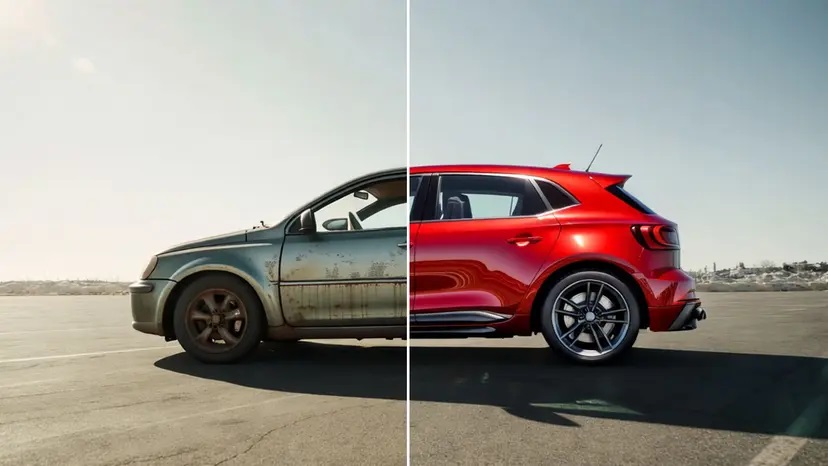
Decart’s software suite is anchored by its two core world models: Lucy and Oasis. Lucy represents a significant leap in video transformation technology. Unlike earlier iterations of generative video that suffered from temporal drift—where mistakes at the start of a video propagate and ruin later frames—Lucy implements a self-correcting training loop. By exposing the model to its own imperfect outputs, Decart has enabled a form of autonomous iterative improvement.
The industrial implications are stark. For retail and interior design, Lucy allows for real-time augmentation that could redefine e-commerce and virtual staging. Perhaps more importantly, the integration of Lucy with Oasis—which generates complex 3D simulated environments—provides a critical feedback loop for robotics development. By creating millions of synthetic variations of warehouse scenarios, Decart is effectively providing a digital twin environment where robotic agents can experience a thousand lifespans of training before touching a physical product.
A Strategic Trajectory for the AI Ecosystem
The rapid influx of capital into Decart reflects an evolution in investor sentiment. The industry is moving past the phase of blind investment in LLMs and into a period of infrastructure refinement. As the AI market matures, the competitive advantage will shift away from those who simply own the most compute, and toward those who can orchestrate that compute most efficiently.
Decart’s ability to draw deep-pocketed strategic investors from both the hardware (Nvidia) and application (Adobe) spaces suggests that their DOS platform is viewed as essential connective tissue for the next phase of foundation model deployment. With plans to expand its product offerings in the coming weeks, Decart is moving quickly to establish itself as the de facto standard for hardware-agnostic AI, reducing the friction that currently prevents models from scaling across the global cloud infrastructure.