
The Weaponization of Trust: Deconstructing the ‘ApocalypseZ’ Campaign
The sophisticated phishing attack launched against Donncha Ó Cearbhaill, head of Amnesty International’s Security Lab, underscores a critical shift in state-sponsored cyber warfare. By targeting a high-profile security researcher, the threat actors demonstrated a dangerous level of audacity, yet the incident serves as a vital case study in how advanced persistent threats (APTs) are evolving beyond simple credential harvesting.
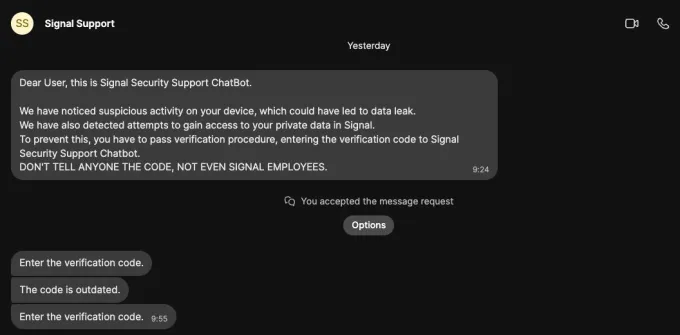
The attack utilized a social engineering tactic designed to exploit the inherent trust users place in official platform notifications. By masquerading as a Signal security bot, the attackers attempted to manipulate Ó Cearbhaill into revealing a verification code—a classic session hijacking maneuver. Had this succeeded, the attackers would have effectively enrolled their own device as a secondary, malicious client, granting them silent access to the victim’s entire message history and future communications.
The Mechanics of the ‘Snowball’ Strategy
Analysis of the campaign reveals the use of an automated toolkit identified as ApocalypseZ. This platform represents a significant leap in industrializing Signal-based espionage. By automating the delivery of messages and the translation of stolen data into Russian in real-time, the operators have minimized the manual labor required to conduct large-scale, individualized campaigns.
More concerning is the snowball propagation model identified by Ó Cearbhaill. The attackers appear to be leveraging compromised accounts to harvest contact lists, effectively using one victim as a bridgehead to reach others within the same professional or social circles. This lateral movement mimics the spread of computer worms, but through the medium of human social networks, significantly increasing the probability of success when a message appears to come from a known contact.
Attribution and Industrialized Espionage
The alignment of this campaign with warnings from CISA, U.K. authorities, and Dutch intelligence services reinforces the assessment that Russian-affiliated actors are behind the operation. The forensic evidence—specifically the Russian-language interface and core codebase—points toward a well-resourced state operation rather than opportunistic cyber-criminals.
This development highlights a troubling trend: the movement of high-value targets onto encrypted messaging apps has not stopped state actors; it has simply forced them to improve their phishing methods. These groups are no longer relying on clumsy malware links; they are targeting the identity verification layer of the applications themselves.
Mitigation and Defensive Posture
The professional implication for cybersecurity practitioners is clear: identity is the new perimeter. As these platforms introduce more sophisticated end-to-end encryption, the attack vector shifts inevitably toward account takeovers via social manipulation.
For the average user—and even high-risk individuals like journalists and researchers—the focus must shift toward hardening account registration. The Registration Lock feature within Signal is the single most effective defense against this specific class of attack. By requiring an independent PIN to re-register a phone number on a new device, users create a secondary layer of authentication that survives even if an attacker manages to intercept an SMS or verification code.
As these automated ApocalypseZ campaigns continue to scour networks for new victims, the security community must balance the need for user privacy against the existential risk of automated social engineering. The fact that the attackers inadvertently targeted one of the world’s most prominent security investigators suggests that these mass-targeting bots are indiscriminate, yet the defensive strategies they trigger may ultimately lead to a more robust, hardened ecosystem for all users.