
Cerebras Defies Market Trepidation with Multi-Billion Dollar IPO
Cerebras Systems Inc. has officially set the price for its initial public offering at $185 per share, far exceeding its initial projected range of $150 to $160. This aggressive pricing catapults the company to a fully diluted market capitalization of $56.4 billion. Raising at least $5.5 billion, the offering marks a watershed moment for the semiconductor industry, representing one of the most significant technology IPOs since Uber’s $8 billion debut in 2019 and Snowflake’s $3.8 billion entry in 2020.
The valuation signals a robust investor appetite for hardware alternatives to Nvidia’s dominant graphics processing units (GPUs). With the semiconductor sector seeing a flurry of capital as Intel, AMD, and Micron post significant year-over-year gains, the market is clearly shifting focus toward specialized silicon capable of handling the massive computational demands of the generative AI era.
Navigating the Pivot: From Hardware Reliance to Cloud Services
The road to this public debut was far from linear. Founded in 2016, Cerebras faced significant scrutiny during earlier attempts to go public, particularly regarding its heavy reliance on its single largest customer, the UAE-based G42. Regulatory complications, including a security review by the U.S. Committee on Foreign Investment in the United States, forced the firm to rethink its go-to-market strategy.
The company successfully mitigated these headwinds by diversifying its customer base and moving away from a pure-play hardware sales model toward a cloud-hosted service platform. This strategic pivot allows Cerebras to move into the inference space—the stage of the AI lifecycle where trained models are applied to live data. By offering cloud access to its chips, Cerebras is essentially positioning itself to compete against hyper-scalers like AWS, Google Cloud, and Oracle, effectively entering the infrastructure-as-a-service market.
Architectural Superiority in AI Inference
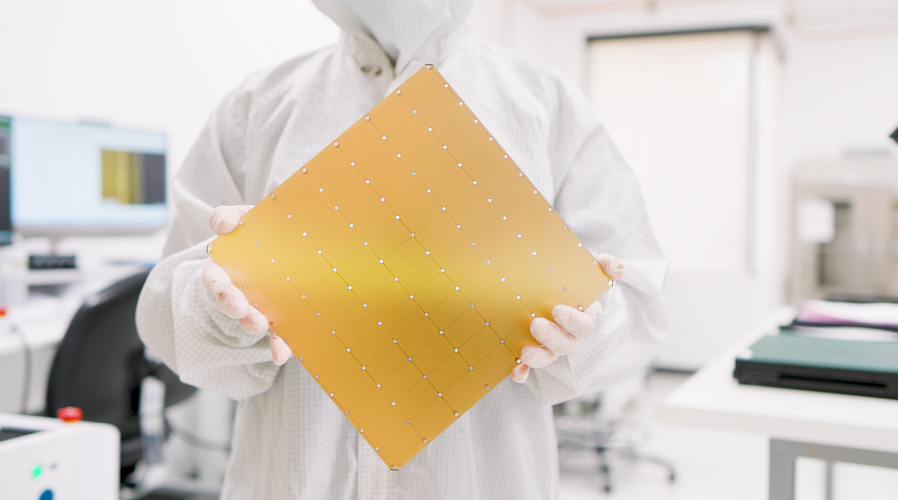
At the core of Cerebras’s value proposition is the WSE-3 processor, a wafer-scale chip that dwarfs the size and power of the standard Blackwell B200 GPU. The technical differentiator lies in its massive 44-gigabyte onboard SRAM cache. By integrating memory directly onto the chip, Cerebras achieves unparalleled latency reduction, enabling 900,000 cores to access data within a single clock cycle.
This architectural departure from the traditional GPU design is what analysts believe will sustain the firm’s long-term growth. Because inference is inherently memory-bound, the WSE-3’s design provides a tangible performance edge over GPUs for high-speed AI tasks. As noted by Holger Mueller of Constellation Research, the success of this IPO is a validation of the need for specialized silicon to drive down enterprise AI costs, which in turn fuels further adoption and industry innovation.
Strategic Partnerships and Future Outlook
Cerebras has taken aggressive steps to secure its market position. The company has moved from being dependent on a single entity to forging significant high-profile partnerships. Notably, a $20 billion compute capacity agreement with OpenAI and a looming integration with Amazon Web Services’ Bedrock service suggest that major AI players are viewing Cerebras as a necessary component of their hardware supply chain diversity.
While institutional investors such as Fidelity and Benchmark hold substantial positions, the inclusion of industry titans like OpenAI’s Sam Altman and Greg Brockman among pre-IPO shareholders underscores the insider belief in the firm’s trajectory. As the company begins trading under the ticker CBRS, the focus will shift from its impressive fundraising haul to its execution—specifically its ability to penetrate the competitive cloud infrastructure market and prove that wafer-scale computing can become the industry standard for large-scale AI inference.