
Breaking the 70% Efficiency Barrier in Digital Imaging
The digital imaging sector, a market saturated with over 7 billion sensors sold annually, has operated under a restrictive technical paradigm for half a century. Despite rapid advancements in software and post-processing, the underlying hardware—specifically the color filter array—has remained fundamentally inefficient. Netherlands- and Belgium-based startup eyeo B.V. is aiming to dismantle this constraint, announcing a €40 million Series A funding round to bring its nanophotonic “color-splitting” technology to mass-market commercialization.
This substantial capital injection, which brings the company’s total funding to €55 million, was led by Innovation Industries and supported by a consortium of strategic stakeholders, including imec.xpand, Invest-NL Deep Tech Fund, and the European Union’s InvestEU Fund. Such significant backing underscores the industry’s desperate thirst for a solution to the light-rejection dilemma that currently defines every major camera sensor on the market.
The Fundamental Engineering Flaw
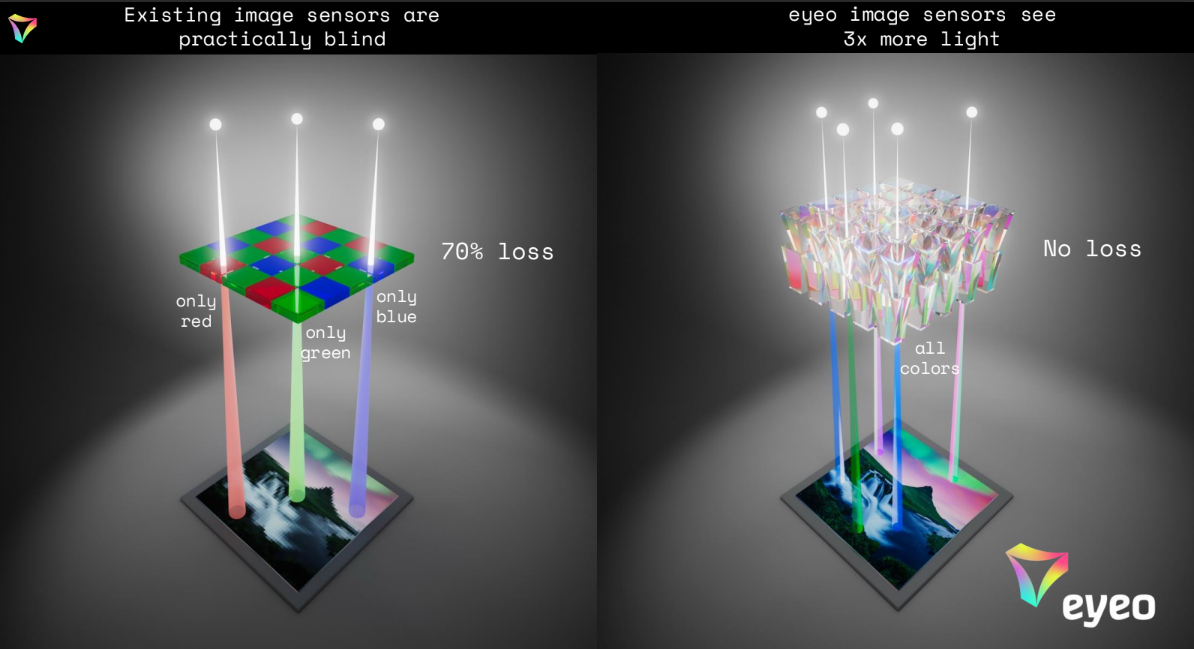
Standard digital image sensors rely on a color-filtering mechanism that is inherently subtractive. To capture a color image, sensors discard up to 70% of the incoming light, essentially throwing away the majority of the signal to isolate primary colors. This inefficiency forces camera manufacturers to choose between pixel size, resolution, and low-light performance, as they are constantly fighting against the photon loss dictated by traditional filter arrays.
Eyeo’s shift in approach is architectural. Instead of filtering out light, the company’s proprietary nanophotonic technology splits photons into their constituent color components and directs them to the appropriate pixel. By preserving light that was previously discarded as waste, eyeo claims its technology effectively triples light sensitivity. This leap in performance represents a structural improvement that enhances resolution and color accuracy without requiring larger physical sensors—a critical bottleneck for the smartphone and autonomous vehicle industries.
Implications for the Semiconductor Ecosystem
The significance of eyeo’s progress lies in its compatibility. The company has verified that its color-splitting technology integrates directly into existing Complementary Metal-Oxide Semiconductor (CMOS) sensor platforms. This is a vital strategic advantage; it allows tier-one manufacturers to adopt eyeo’s innovation without scrapping existing semiconductor foundry workflows.
By removing the 50-year-old tradeoff between sensor size and image quality, eyeo is effectively widening the ceiling for what mobile devices and medical imaging hardware can achieve. As artificial intelligence and computer vision systems become more pervasive, the demand for high-fidelity, high-sensitivity data in low-light environments is exploding. Eyeo’s technology is positioned to become a foundational component for the next generation of visual sensing, moving from the prototype stage to high-volume manufacturing.
Capitalizing for Scale
With the Series A funding secured, eyeo is transitioning from a research-and-development focus to a commercial scaling phase. The primary objective is to build out internal engineering and manufacturing capacity to support early tier-one customers. Beyond immediate shipments, the capital will fuel the R&D pipeline for a second generation of color-splitting platforms.
For the broader tech ecosystem, eyeo represents a shift toward more efficient, hardware-level optimization. Investors view the startup not merely as a component supplier, but as a pioneer forcing a long-overdue evolution in semiconductor architecture. If eyeo successfully achieves mass-market deployment, it stands to redefine the standards of visual data capture across the entire consumer electronics and industrial automation landscape.