
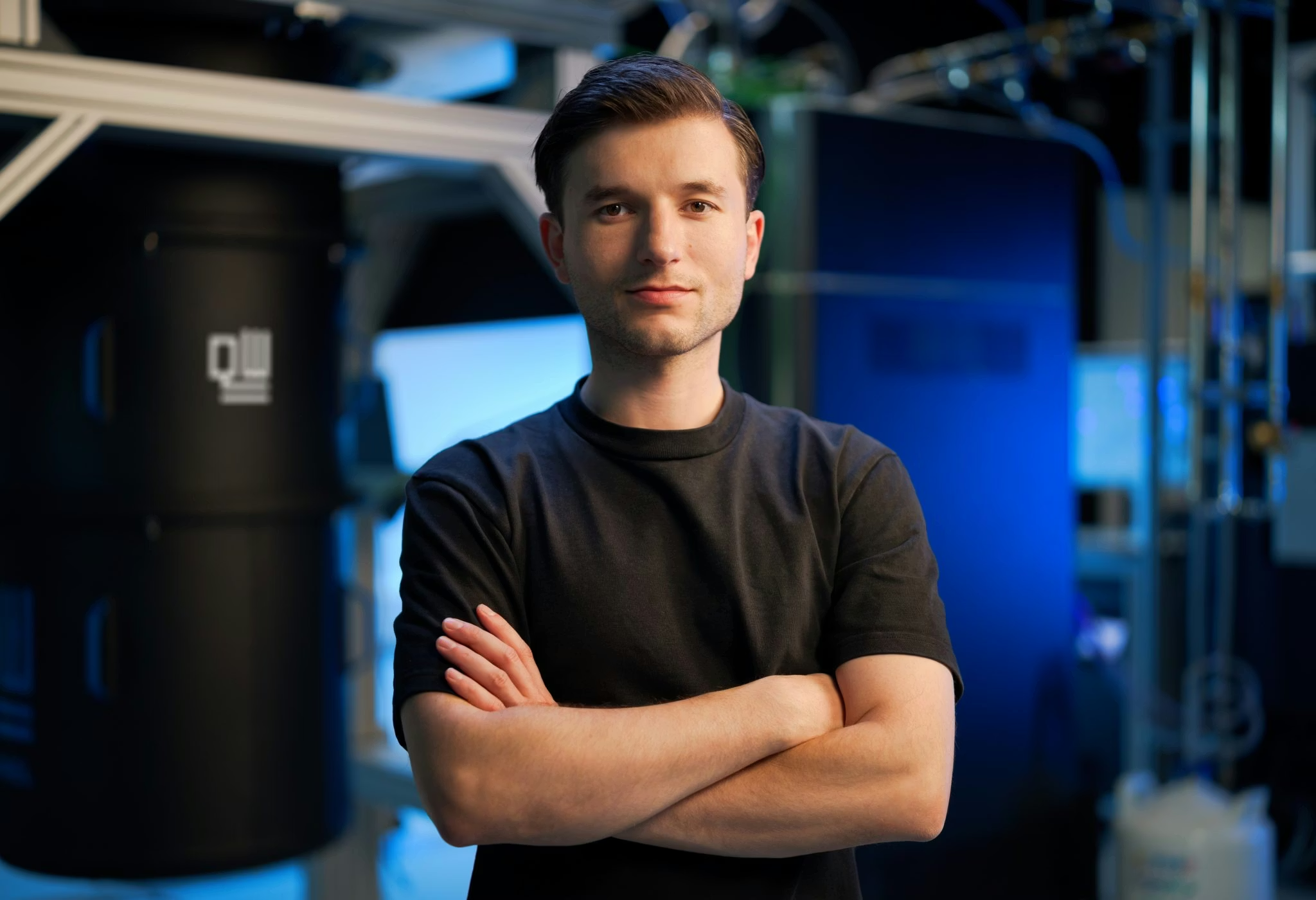
The Strategic Shift Toward Quantum Industrialization
The quantum computing sector has entered a critical consolidation phase, moving away from academic experimentation and toward mass manufacturing. Delft-based Quantware has secured $178 million in Series B funding, a significant capital infusion that marks a pivotal moment for European deep tech. By attracting heavyweights like Intel Capital alongside venture arms connected to the US intelligence infrastructure, the startup is signaling that quantum hardware is no longer a R&D curiosity—it is a critical national security and industrial asset.
This funding round, trailing the massive raises of IQM and Pasqal, solidifies Europe’s position as a powerhouse for quantum fabrication. However, the true significance lies in the investor profile. When semiconductor incumbents and intelligence-backed non-profits align, it suggests that the market for quantum hardware is moving toward a standardized, high-volume model, effectively mirroring the trajectory of traditional silicon-based chip manufacturing.
Solving the Density Bottleneck
The primary roadblock to achieving quantum advantage remains the wiring nightmare. Classical supercomputers are constrained by heat and space, but quantum chips face an even steeper challenge: signal routing. Currently, nearly 90% of a quantum chip’s surface area is dedicated to necessary infrastructure, leaving minimal room for the qubits themselves.
Quantware’s core value proposition is an architectural overhaul specifically engineered to solve this spatial inefficiency. CEO Matt Rijlaarsdam’s observation that a million-qubit device would require a footprint as expansive as Central Park highlights the futility of current design standards. By drastically increasing qubit density, Quantware intends to circumvent these exponential scaling issues. The company claims its proprietary routing logic can improve density by two orders of magnitude, a prerequisite for practical, fault-tolerant computation.
Democratizing the Manufacturing Stack
Unlike competitors that operate as black-box hardware providers, Quantware is pursuing a dual-track business model. It functions as both a boutique manufacturer of high-performance quantum processors and a provider of foundational architecture for the wider ecosystem. This is a savvy play designed to prevent the fragmentation of the quantum industry.
By licensing its scaling architecture—specifically tailored for superconducting qubits—to third-party manufacturers, Quantware is effectively attempting to become the standard-bearer for quantum chip design. This Intel inside strategy for quantum processors allows the company to harvest revenue from multiple segments of the value chain, insulating it against the volatility inherent in building comprehensive quantum systems from scratch.
Capacity Expansion and Market Readiness
The immediate priority for the fresh capital is the launch of an industrial-scale fabrication facility in the Netherlands. Currently, the company has established a footprint in over 20 countries with a customer base exceeding 50 entities; however, laboratory-scale production will not suffice for the next decade of requirements.
Tripling down on production capacity is a direct response to the global race to reach the 10,000-qubit milestone. If Quantware can deliver on its promise to ship 10,000-qubit-capable architectures by 2028, it will shift the industry paradigm from testing proof-of-concept devices to building the machines that catalyze breakthroughs in materials science, cryptography, and logistical optimization. For the European tech landscape, the success of this facility will be the ultimate test of whether the region can transition from theoretical excellence to the commercial dominance of the next-generation global computing infrastructure.