
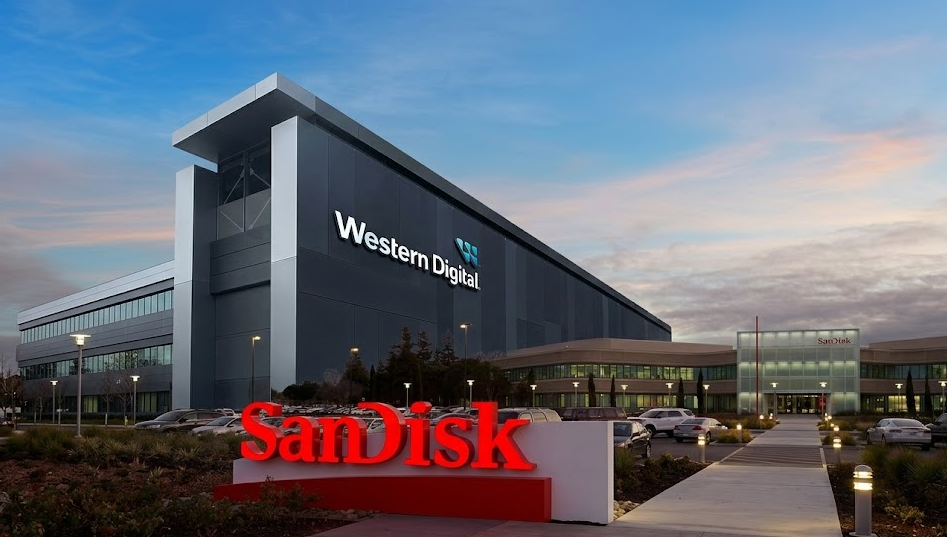
The Structural Shift in Data Infrastructure: Memory and Storage Ascend
The latest earnings reports from Western Digital and Sandisk serve as a definitive market barometer for the AI era. Both firms significantly outperformed Wall Street expectations, underscoring a reality that industry analysts have hinted at for months: the physical layer of the AI stack is becoming as critical—and as profitable—as the software layer itself.
Western Digital posted adjusted earnings of $2.72 per share, comfortably clearing the $2.39 forecast, while total revenue surged 45% to $3.34 billion. Sandisk’s performance was even more dramatic, with a 251% revenue jump to $5.95 billion, fueled by a relentless appetite for high-speed flash and memory components.
The Persistent Data Mandate
The core driver behind these figures is the transition from experimental AI to operationalized, large-scale deployment. As Western Digital CEO Irving Tan noted, every facet of modern AI—from training large language models to agentic and physical AI applications—relies on persistent, cost-effective storage.
Unlike the volatile cache memory used during initial computation, persistent storage has become the bottleneck for companies attempting to manage the massive datasets required for model training and inference. The industry is witnessing a strategic pivot where storage is no longer viewed as a commodity, but as a specialized component of the compute fabric.
Strategic Volatility and Market Sentiment
Despite the stellar performance, market reactions have been tempered. Both Western Digital and Sandisk saw after-hours declines as investors weighed impressive guidance against broader concerns regarding the sustainability of the AI expenditure boom. Recent speculation regarding OpenAI’s growth targets has sensitized the market to any sign of a cooling trend in AI investment.
However, the fundamental metrics of physical infrastructure suppliers suggest a disconnect between investor caution and the reality of orders on the books. With the hyperscalers—Amazon, Google, Microsoft, and Meta—committing over $700 billion to capital expenditure this year, the demand for high-performance memory is mathematically guaranteed for the near term.
Building Capacity Amid Inventory Constraints
Sandisk CEO David Goeckeler highlighted a crucial supply-side reality: capacity expansion is a lagging indicator. Even as Sandisk shifts toward longer-term, high-value customer commitments, new production lines are not expected to reach optimal utilization until mid-2025.
This creates a structural supply deficit. For investors and industry observers, this implies that pricing power will remain firmly with the suppliers. As long as inventory remains constrained, the combination of rising demand and limited manufacturing throughput will likely sustain elevated margins for the semiconductor and storage sectors well into the next fiscal cycle.
Implications: A Fundamental Inflection Point
The shift within these companies toward multiyear, fixed-financial-commitment contracts suggests a move away from the boom-and-bust pricing cycles that have historically plagued the memory industry. By effectively locking in large-scale data center clients, firms like Sandisk and Western Digital are attempting to stabilize their earnings profiles, signaling that the current AI build-out is viewed by industry leaders as a multi-year transition rather than a temporary spike.
While individual stock prices remain subject to broader market volatility, the underlying data points to a sustained transformation in enterprise hardware. The market is effectively pricing in a future where memory and storage provide the foundation for the entire digital economy, securing their role as the primary beneficiaries of the generative AI revolution.